If you’ve ever felt like your marketing tasks multiply the moment you check them off, you’re not imagining it. Most teams are trapped in a cycle of manual busywork: sending emails one by one, tagging leads, updating CRMs, juggling multiple channels, and trying to stitch data together from scattered tools.
Smart marketing automation changes that rhythm completely. What this really means is you stop performing repetitive tasks yourself and start building a system that performs them for you consistently, accurately, and at scale.
But here’s the thing: while most guides talk about templates and simple triggers, the real power of smart automation lies in what many blogs skip: unified data, AI-driven triggers, multichannel orchestration, lifecycle automation, and the long-term operational structure that keeps everything running without breaking. So let’s break it down.
The Foundation: Smarter Workflows, Less Manual Work
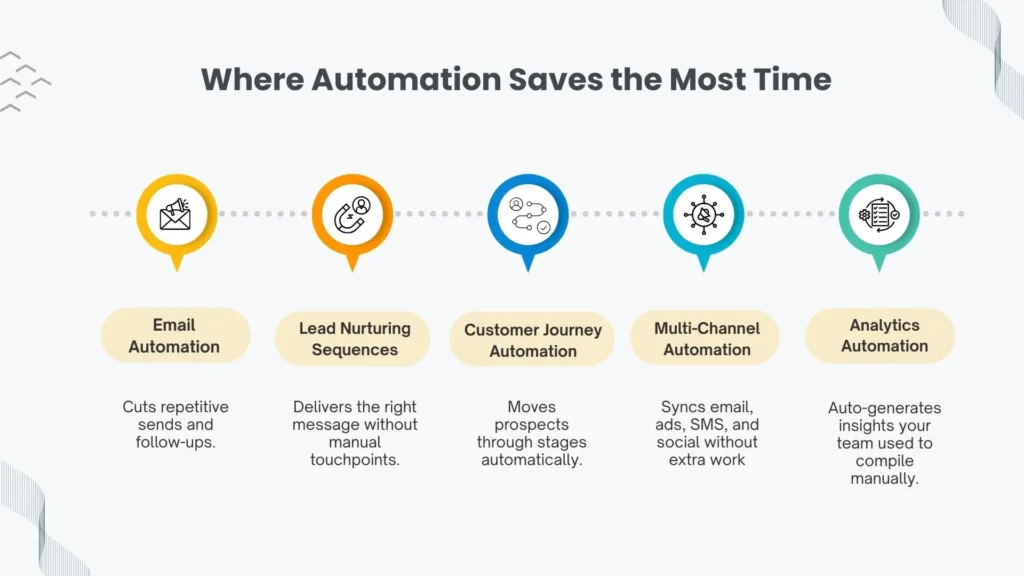
Most teams start with basics like email automation, welcome flows, and simple lead nurturing. That’s useful, but it barely scratches the surface. The real time savings kick in when you build marketing automation workflows that link your CRM, analytics, communication channels, and content engine into one connected system.
Imagine this flow:
- A visitor downloads a guide.
- They’re tagged automatically based on behavior.
- They enter a tailored lead nurturing track.
- They get relevant content based on intent signals.
- If they show buying interest, your CRM updates automatically.
- Your team is alerted only when human interaction is actually needed.
That’s the difference between automated and smart automated marketing.
And when you use customer journey automation, you’re not just automating tasks, you’re shaping a predictable, optimized conversion path where each step adapts to the person’s behavior.
The Hidden Power: Your Data Infrastructure
Most blogs skip this part. But smart automation depends on data hygiene and structure.
You can’t personalize effectively if your data is chaotic. You can’t build meaningful workflows if your CRM, website forms, analytics, and email tools aren’t speaking to each other.
Here’s where a strong marketing automation company builds the backbone: unified customer profiles, clean tagging logic, and synced CRM fields that never fall out of date.
Once your data foundation is set, your automated marketing services don’t just push messages. They connect the dots. They read behavior. They adapt.
That’s where dynamic content personalization becomes powerful. Instead of blasting the same content to everyone, your system automatically adjusts subject lines, CTAs, and even entire content blocks based on user segments and real-time behavior.
AI-Powered Automation: The Part Most People Still Miss
You’ll see a lot of content about basic workflows. But the shift happening now is all about predictive, adaptive automation.
Here’s how AI makes automated marketing smarter:
- Predicting when a lead is most likely to convert.
- Triggering messages based on likelihood, not just simple actions.
- Scoring leads based on thousands of micro-behaviors.
- Generating personalized content variations automatically.
- Recommending next-best actions for each customer.
This takes marketing automation services beyond preset sequences and turns them into self-learning systems that adjust over time.
Multi-Channel Automation: Where the Real Time Savings Happen
Most teams think automation is just about email. That’s the old model.
The modern workflow uses multi channel automation to sync:
- SMS or WhatsApp
- Social media touchpoints
- Retargeting ads
- Website personalization
- CRM onboarding
- Customer service triggers
What this means is your leads experience one continuous journey regardless of platform. You’re not repeating tasks across tools. You’re connecting everything once and letting the system handle the rest.
This reduces hours of manual effort each week, especially when your automations handle segmentation, tagging, routing, and lead qualification without your team touching anything.
Mapping the Customer Journey With More Precision
Smart automation isn’t just about speed. It’s about relevance.
You’re not sending more messages. You’re sending the right messages and only when the customer is ready.
Using customer journey automation, you can build pathways that branch based on:
- Pages visited
- Time spent on the website
- Lead source
- Content interactions
- Product interest
- Purchase history
- Engagement level
Instead of forcing everyone through the same funnel, each lead gets their own route, the one that shortens their buying timeline.
The Often-Ignored Stage: Retention and Post-Purchase Automation
Most blogs only talk about top-of-funnel workflows. But the real ROI comes from the customers you keep.
Smart customer retention automation gives you:
- Renewal reminders
- Loyalty messaging
- Upsell recommendations
- Win-back flows
- Post-purchase onboarding
- Usage-triggered follow-ups
- Churn prediction alerts
And because the system runs these in the background, your team recovers hours every week that would otherwise go into follow-ups nobody has time to manage manually.
Operational Efficiency: Building Workflows That Don’t Break
This is another area competitors don’t cover enough. Setting up automation is the easy part. Keeping it running is where the real work happens.
That’s why your setup should include:
- Clear trigger mapping
- Naming conventions
- Version-controlled workflows
- Automated error alerts
- Data validation rules
- Segmentation logic nobody has to guess
Strong execution here means your system scales, no matter how many campaigns or offers you add later.
And this is where expert marketing automation consultation becomes invaluable. Instead of one-off setups, you get long-term operational structure that prevents chaos as you grow.
Smart Workflow Examples Most Teams Overlook
Sure, everyone knows about welcome sequences and abandoned cart emails. But if you want genuine time savings, these overlooked workflows do the heavy lifting:
1. Self-cleaning database automations
Your system automatically removes invalid leads, merges duplicates, updates missing fields, and keeps segmentation clean.
2. AI-driven lead scoring
No more manual checking or guessing who’s hot. Your system calculates likelihood of conversion in real time.
3. Automated creative personalization
Your content blocks switch dynamically based on past behavior, interests, and engagement.
4. Intent-based ad audience syncing
Your ad lists update automatically based on CRM behavior, no exporting or uploading.
5. Cross-channel win-back sequencers
If someone disengages on one platform, another channel picks up the conversation.
6. Lifecycle check-ins
Your system monitors periods of inactivity and triggers proactive touchpoints.
7. Reputation and feedback workflows
Automatic review requests, satisfaction surveys, and follow-ups that would take hours to do manually.
These are the workflows that free up serious time, the kind of time most teams don’t even realize they’re losing.
When Not to Automate — The Missing Side of the Conversation
One of the biggest gaps in popular content is the idea that everything should be automated. It shouldn’t.
Some touchpoints need a human.
A smart system knows when to step back:
- High-value sales conversations
- Sensitive customer issues
- Complex onboarding scenarios
- Creative brainstorming
- Strategic messaging decisions
Automation isn’t about removing people. It’s about removing the friction that keeps people from doing their best work.
Why Teams Save Hours Every Single Week
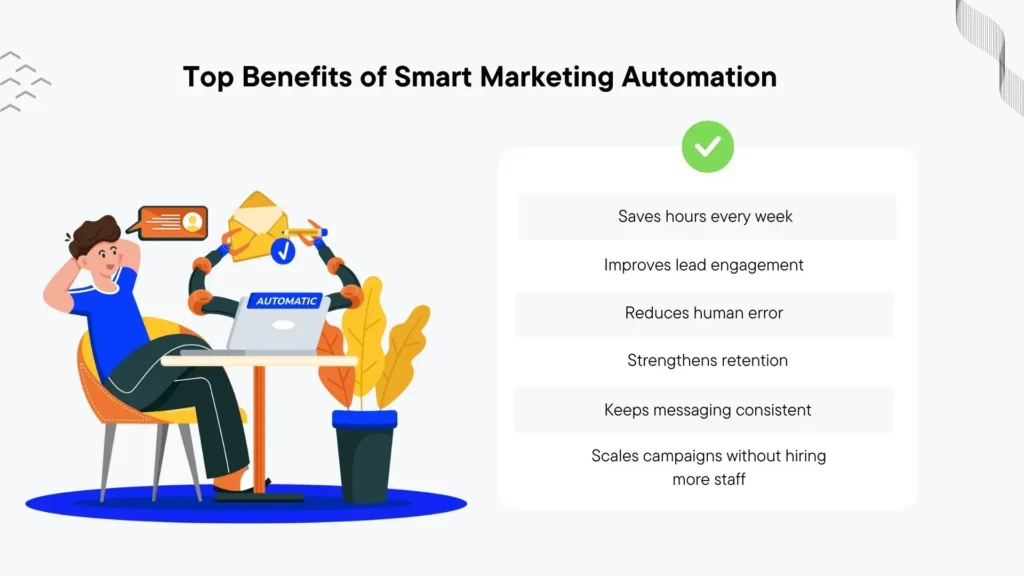
It’s not magic. It’s simply the compounding effect of dozens of small processes that run 24/7 without needing attention.
When you combine automated marketing services, smart workflows, AI triggers, customer journey automation, dynamic content personalization, email automation, lifecycle retention, and unified data, your team goes from reactive to strategic.
You stop fighting fires and start building predictable systems.
You replace guesswork with real signals.
You get back time every day that used to slip away unnoticed.
FAQ’s
It’s automation that adapts to customer behavior, pulls from unified data, and handles repetitive work across channels so your team spends time on strategy instead of manual tasks.
Once your workflows are mapped and triggered automatically, tasks like segmentation, follow-ups, tagging, reporting, and email scheduling happen in the background without human effort.
Start with welcome sequences, lead nurturing, follow-up reminders, abandoned interest flows, and post-purchase journeys. These deliver quick wins and save immediate time.
It sends relevant messages based on behavior, timing, and intent. Instead of generic blasts, customers get content shaped around what they’re actually looking for.
Yes. Modern setups support email, SMS, WhatsApp, ads, CRM updates, social touchpoints, and website personalization, all running from one workflow.
AI predicts when leads are ready, scores engagement, identifies churn risks, and personalizes content without manual adjustments. It makes workflows more accurate and adaptive.