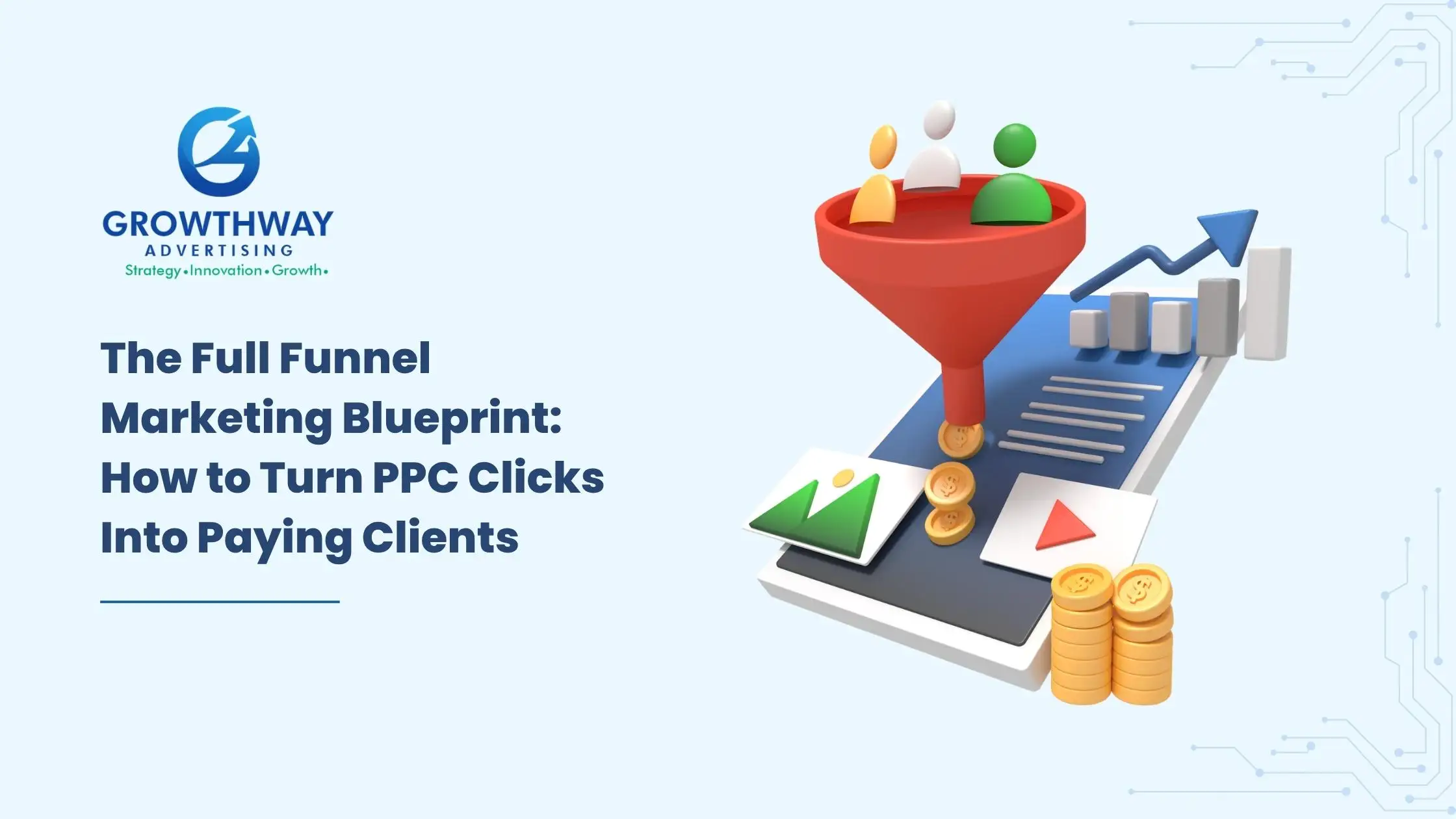
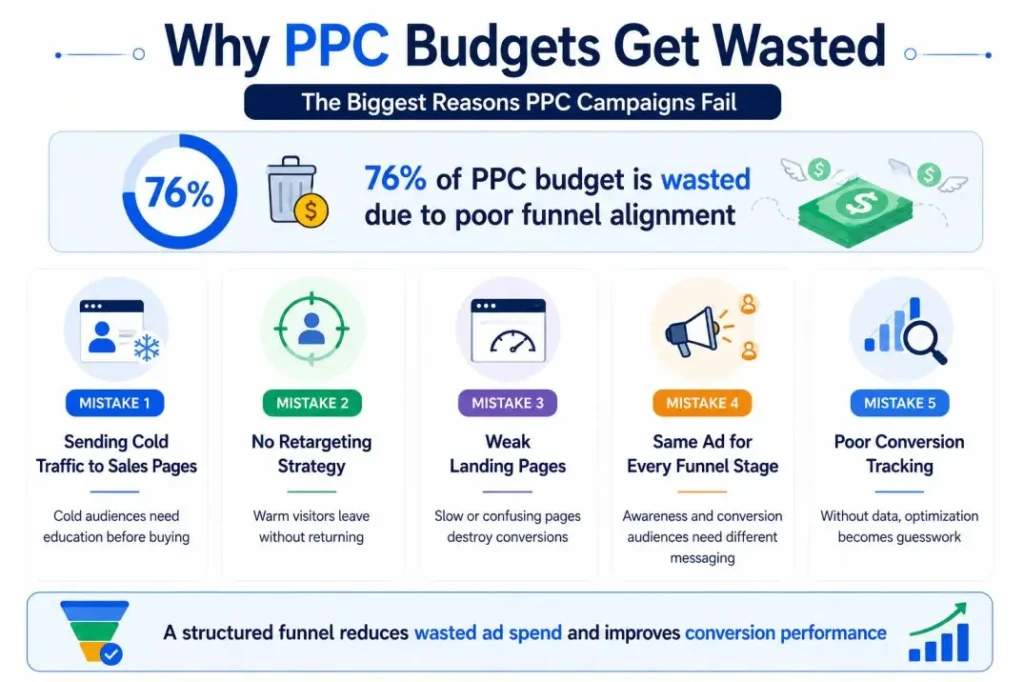
Did you know that businesses waste an average of 76% of their PPC budget due to misaligned funnel strategy? You’re paying for every click, but if those clicks land in the wrong place at the wrong time, you’re essentially funding a leaky bucket. The problem rarely lies in the ad creative or the bidding strategy. It lies in the architecture beneath it.
A sales funnel architecture is the structural backbone that connects your paid ads to your business outcomes. It’s not just about having a landing page, it’s about engineering a deliberate journey that moves a cold stranger through awareness, consideration, and decision with precision. When your funnel architecture is built right, every dollar you spend on PPC has a clear path to return. In this guide, you’ll learn exactly how to design, map, and optimize a high-converting funnel built specifically for paid traffic.
What Is Sales Funnel Architecture?
Sales funnel architecture refers to the deliberate design of every touchpoint, page, audience layer, and conversion path that a paid traffic visitor travels through from first ad impression to final purchase.
Unlike a generic marketing funnel, a PPC funnel strategy is built around one core constraint: you’re paying for every visitor. That changes everything. There’s no room for vague nurturing sequences or passive brand awareness plays. Every stage must be intentional, every page must have a job, and every audience segment must be matched to the right message at the right moment.
For PPC specifically, funnel architecture answers three critical questions: Where is this visitor in their buying journey? What do they need to see next to move forward? And what action should they take right now? When your architecture answers all three across every campaign your conversion rates climb and your cost-per-acquisition drops.
The 3 Core Funnel Stages for PPC
A high-performing PPC funnel strategy is built on three distinct stages, each requiring its own ad strategy, bidding approach, and creative angle.
TOFU — Top of Funnel (Awareness) This is cold traffic. These users don’t know your brand and aren’t actively searching for your solution. On Meta Ads, this looks like broad interest-based or lookalike audience campaigns running video or carousel ads. On Google, this is display or YouTube pre-roll. Your goal here isn’t conversion, it’s qualified exposure. Use CPM or Target Impression Share bidding. Keep CTAs soft: “Learn More,” “Watch Now,” “Discover How.”
MOFU — Middle of Funnel (Consideration) These are warm visitors, people who’ve engaged with your TOFU content, visited your site, or shown intent signals. Retargeting kicks in here. On Meta, you’re serving dynamic ads or testimonial-based creatives to website visitors. On Google, you’re running RLSA (Remarketing Lists for Search Ads) campaigns with adjusted bids. CTAs become more direct: “Get the Free Guide,” “See How It Works,” “Book a Demo.”
BOFU — Bottom of Funnel (Conversion) These users are ready to buy. They’ve compared options and need one final nudge. Here you deploy your highest-intent keywords, competitor campaigns, and urgency-driven creatives. Use Target CPA or Target ROAS bidding. CTAs are sharp: “Start Free Trial,” “Buy Now,” “Get Your Quote Today.”
Designing Your Landing Page Ecosystem
Each funnel stage demands a distinct landing page type. Sending all traffic to a single homepage is one of the fastest ways to destroy your Quality Score and your conversion rate simultaneously.
TOFU Pages are built for lead capture, squeeze pages that offer a high-value lead magnet (checklist, webinar, free tool) in exchange for an email. Keep them simple: one headline, one form, one CTA.
MOFU Pages go deeper, Video Sales Letters (VSLs) or long-form educational pages that address objections, build credibility, and warm the visitor toward a decision. These pages earn trust.
BOFU Pages are your full high-converting landing pages or product/service pages optimized for purchase. Social proof, guarantees, pricing clarity, and urgency elements belong here.
From a PPC perspective, your landing page relevance directly impacts your Google Ads Quality Score, which affects both your ad rank and your cost-per-click. A tightly matched ad-to-page experience doesn’t just convert better, it costs less to run.
Audience Segmentation & Funnel Mapping
Your funnel architecture is only as strong as your audience segmentation. Every stage needs a corresponding audience layer built inside your ad platforms.
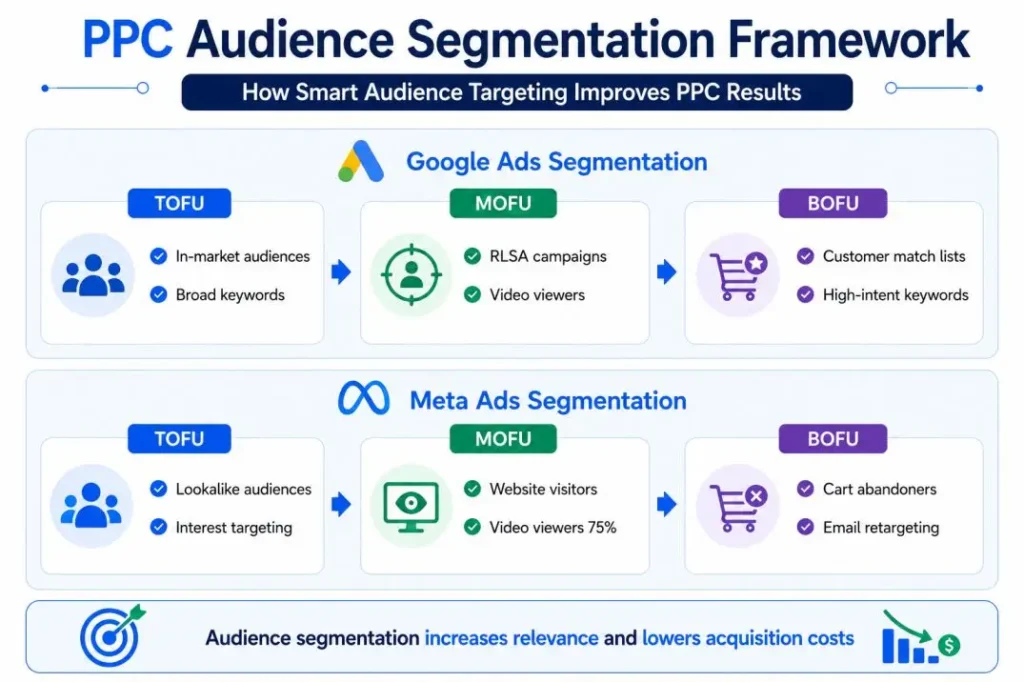
For Google Ads:
- TOFU: In-market audiences layered on broad or phrase-match campaigns
- MOFU: RLSA audiences (visited key pages, watched 50%+ of a YouTube ad)
- BOFU: Customer match lists, cart abandoners, high-intent search terms
For Meta Ads:
- TOFU: Lookalike audiences (1–3%) based on purchasers or high-LTV customers
- MOFU: Custom audiences of video viewers (75%+), page engagers, website visitors (90-day window)
- BOFU: Website visitors (14-day), add-to-cart abandoners, email list retargeting
A real-world example: An e-commerce brand selling premium fitness equipment runs a Meta awareness video campaign targeting a 2% lookalike of their buyers. Viewers who watch 75% of the video are pushed into a MOFU retargeting campaign featuring a VSL and customer testimonials. Those who click but don’t purchase enter a BOFU campaign with a limited-time offer closing the loop cleanly across all three stages.
Tracking, Attribution & Funnel Optimization
You cannot optimize what you cannot measure. A high-converting funnel architecture requires a bulletproof tracking setup from day one.
Start with micro and macro conversions. Macro conversions are your primary goals: purchases, form fills, and booked calls. Micro conversions are the signals leading there, video views, scroll depth, button clicks, page visits. Track both in GA4 and your ad platforms.
Ensure your Meta Pixel and Google Tag are firing correctly on every funnel page. Use UTM parameters on every ad URL to track traffic sources, campaigns, and stages in GA4. This allows you to see exactly where visitors drop off and where the budget is being wasted.
For attribution, use data-driven attribution in Google Ads if your account has sufficient conversion volume. This gives proper credit to TOFU and MOFU touchpoints that assisted the final conversion, rather than over-crediting the last click.
Review funnel performance weekly. If TOFU CPMs are rising, test new creatives. MOFU CTR is low, adjust your retargeting message. If BOFU conversion rate drops, test a new offer or add a guarantee.
Common Funnel Architecture Mistakes to Avoid
Even experienced PPC managers make these structural errors:
- Sending cold traffic directly to a sales page — Cold audiences need education first. Skipping TOFU and MOFU stages leads to high bounce rates and wasted PPC spend.
- No retargeting layer — If you’re not recapturing warm visitors, you’re leaving the majority of your potential conversions on the table.
- Using the same creative across all funnel stages — A TOFU ad should spark curiosity. A BOFU ad should create urgency. Same creative kills campaign performance at both ends.
- Ignoring post-click experience — A great ad means nothing if the landing page is slow, mismatched, or confusing. Your funnel lives and dies after the click.
- Siloed campaign management — Running TOFU, MOFU, and BOFU campaigns as disconnected efforts rather than a coordinatedPPC funnel strategy destroys efficiency and attribution clarity.
Actionable Takeaway: Audit your current campaigns against these five mistakes, fixing even one can significantly reduce your cost-per-acquisition.
Conclusion
Building a high-converting sales funnel architecture isn’t about complexity, it’s about intentionality. When every ad, audience, and landing page is aligned to the right stage of the buyer journey, your PPC investment compounds rather than leaks. Start by mapping your current campaigns to the three funnel stages, build dedicated landing pages for each, and layer your audience segmentation to match.
Ready to put this into action? Conduct a full funnel audit of your current PPC campaigns this week. Identify which stage each campaign serves, check if your landing pages match, and verify your conversion tracking is capturing both micro and macro conversions. A well-architected funnel is your highest-leverage PPC asset.
Let Growthway Simplify Your PPC Funnel Strategy
From building high-converting funnel architectures and setting up audience segmentation to launching full-funnel PPC campaigns and tracking ROI at every stage, Growthway Advertising provides expert ppc services in india and strategic ppc management service support for B2B teams and business owners. Through proven funnel frameworks and experienced PPC strategists, Growthway helps growing businesses stay conversion-ready, cost-efficient, and fully aligned with every stage of the customer journey.
FAQ’s