Here’s the thing: even with marketing automation, many businesses leave more than 30 percent of potential ROI on the table due to poor implementation. As automation becomes more powerful, powered by AI-driven workflows, hyper-personalization, and real-time multi-channel orchestration, these marketing automation pitfalls aren’t just technical hiccups; they can choke your lead flow and stunt revenue growth.
In 2025, marketing automation is no longer just about drip emails or canned nurture sequences. It’s AI-augmented lead scoring, predictive analytics, dynamic content, and fully synced CRM workflows. Yet many teams struggle to extract full value. In this article, you’ll learn how to identify and fix the most costly marketing automation mistakes, from broken CRM integration to stale data hygiene. You’ll also get actionable advice (and proven tools) to optimize your system and when you might want to bring in expert help, like a marketing automation consultation.
Why Marketing Automation Still Fails Many Businesses
Even with cutting-edge tools, automation projects stumble. Why? Two main culprits:
- Over-reliance on tools over strategy
Most organizations purchase automation platforms and proceed to instantaneously roll out workflows without aligning marketing and sales objectives. The automations may not shift the business needle without having a clear strategy.
- Lack of data alignment and cross-functional collaboration
According to recent high-level surveys, over 50 percent of marketers say integrating automation with existing systems is their biggest challenge. When your CRM, email tool, and other systems don’t communicate cleanly, lead generation automation breaks down, and your team ends up chasing data instead of leveraging it.
The result? Automation projects that drag on, generate poor-quality leads, and eventually fail to deliver ROI.
8 Common Marketing Automation Pitfalls
These are eight common marketing automation errors, and the practical implications and solutions.
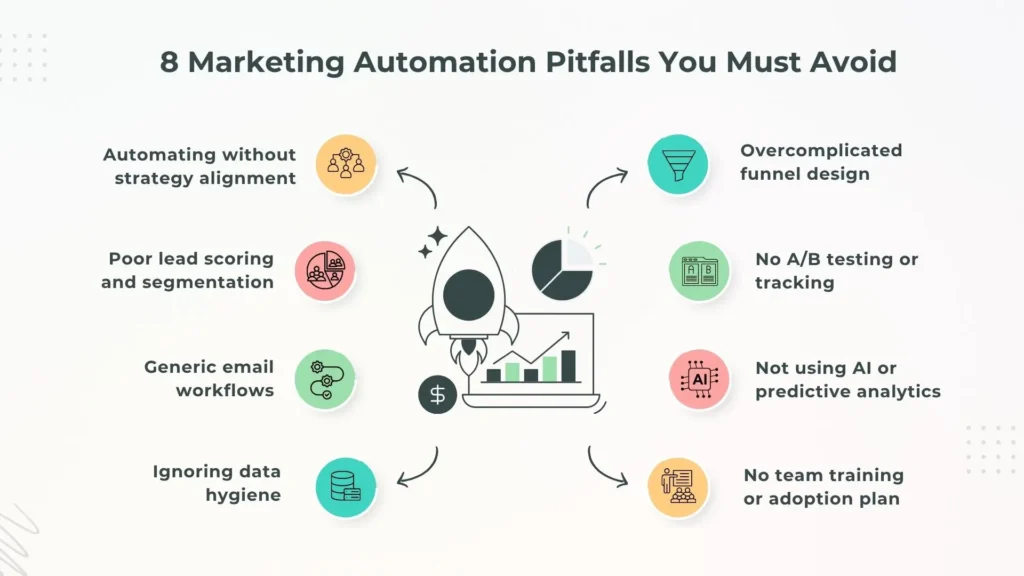
1. Automating Before Strategy Alignment
Scenario: The marketing team launches a nurture sequence immediately after a contact signs up, but sales says none of these leads are “sales-ready.
Impact: Misaligned workflows waste marketing effort and annoy sales (or lead to ignored leads).
Fix: Before building any automation, run a strategy alignment session with marketing and sales. Setting up of shared lead stages, handoff requirements, and qualification of both teams. Create a simple service-level agreement (SLA) so both sides know when a lead moves from automation into active sales engagement.
Tool: Have a collaborative, visual tool (such as a collaborative whiteboard in Miro or Lucidchart) to sketch out the customer journey and where the automation gaps will be filled in.
2. Poor Lead Scoring or Segmentation
Scenario: You are emailing the same nurture to the visitors of the site without considering their level of engagement, or their position on the funnel.
Impact: Over-emailing low-interest contacts, or under-nurturing high-potential ones. Engagement drops; conversion rates decline.
Fix: Develop a lead scoring model that will factor in behavior (e.g., page views, form submissions), firmographic (when B2B) and demographic indicators. Use that score to trigger different workflow paths. e.g., “high score → sales-notify” vs. “low score → light nurture.”
Tool: Lead scoring is available on most CRMs/automation platforms (HubSpot, Salesforce Pardot).For AI-powered predictive scoring, consider tools like Clay or 6sense which integrate with CRMs to enrich and score leads automatically.
3. Generic Email Workflows Without Personalization
Scenario: The welcome or nurture sequence you are using is all-template and impersonal, you’re using the same subject line, content blocks, and send timing for everyone.
Impact: Decreased open rates, low engagement, and unsubscribes.
Fix: Layer in dynamic content and personalization based on segmentation. Insert behavioral based triggers (e.g. when somebody clicked a link on pricing, follow-up with a feature oriented follow-up). Optimize the subject lines, send times, and content using A/B testing.
Tool: Popular platforms like HubSpot, Marketo, or ActiveCampaign support conditional logic in workflows. For next-gen personalization, leverage AI (e.g., generative models) to tailor email copy or subject lines.
4. Ignoring Data Hygiene and CRM Sync Issues
Scenario: Your CRM has duplications of records, old contacts and irregular field mappings. Automated campaigns run into broken logic, or emails bounce frequently.
Impact: Wasted spending, low deliverability, and inaccurate analytics.
Fix: Implement a data hygiene strategy. Turn in your database and dedupe it on a regular basis, verify email addresses, and harmonize field use across systems. Make CRM and automation systems aligned with data mapping platforms that are reliable.
Tool: Deduplication tools (such as HubSpot deduplication), and identity resolution / unification (Customer Data Platforms) help to keep the contact view clean and unified. As identified by strategy guides, the inability to unify identity among systems may derail AI processes.
In addition, schedule routine maintenance procedures by setting up regular cleaning schedules monthly, quarterly, etc.
5. Overcomplicating Funnel Design
Scenario: You’ve built elaborate workflows with too many branches, wait-times, and nested conditions.
Impact: Contacts are stuck, the workflow is broken and it is hard to track performance or debug.
Fix: Simplify your automation. Start with minimal viable workflows. Ask: does each branch serve a distinct, measurable purpose? If not, trim it. Test workflows on a small subset before scaling.
Tool: Workflow audit tools are made in-platform. As an example, workflow performance analytics by HubSpot will allow you to monitor enrollment, conversion, and drop-off. Also, with third-party tools such as Make.com or n8n.io, it is easy to prototype or make automations more modular before production.
6. Lack of Performance Tracking or A/B Tests
Scenario: You’ve set up your automations, but you never revisit how they’re performing. No tests, no optimization, no analysis.
Impact: Low conversion rates, unnoticed errors, and missed growth opportunities.
Fix: Build a continuous optimization framework:
- Define key metrics (e.g., open rate, click-to-conversion rate, lead-to-opportunity rate).
- A/B test subject lines, send times, content.
- Review results monthly, and iterate on failures.
Tool: Utilize native analytics in your automation engine, or tie into BI tools such as Google Data Studio or Power BI to get more detailed dashboards.
7. Failure to Integrate AI and Predictive Analytics
Scenario: You have high-volume workflows, but you never tap into predictive scoring, churn models, or AI-driven content.
Impact: You are not experiencing efficiency and additional personalization, as well as future-moving optimization benefits, particularly in the era of AI-first.
Fix: Invest in AI-driven automation:
- Use predictive lead scoring to prioritize high-intent prospects.
- Leverage AI to generate personalized email copy or recommend content.
- Use predictive analytics to forecast customer behavior and adjust workflows accordingly.
Tool: Use LLM or predictive tools (such as Clay, 6sense or AI agents) with your CRM. According to recent strategy guides, bad data quality is among the leading causes of automation failure but once it is fixed, AI workflows can be used to generate enormous value.
Besides, Neil Patel states that the percentage of marketers that now automate AI workflows is only 6, which is why the opportunity is significant.
8. Not Training Teams on New Systems
Scenario: You rolled out a new automation or CRM tool but gave minimal training to your team. As a result, workflows are under-used, or worse, misused.
Impact: Features go unused, misconfigurations occur, and ROI suffers.
Fix: Implement a training and enablement program. Hold role-specific sessions: sales, marketing, ops. Bring in vendor reps when needed. Document standard operating procedures, and build feedback loops so you can refine workflows over time.
Tool: Use your LMS (Learning Management System) or knowledge base (e.g., Notion, Confluence) to host training materials. Involve vendor support or partner agencies for deep-dive workshops.
How to Future-Proof Your Automation
To stay ahead in 2025, here’s how to build automation that’s resilient to change:
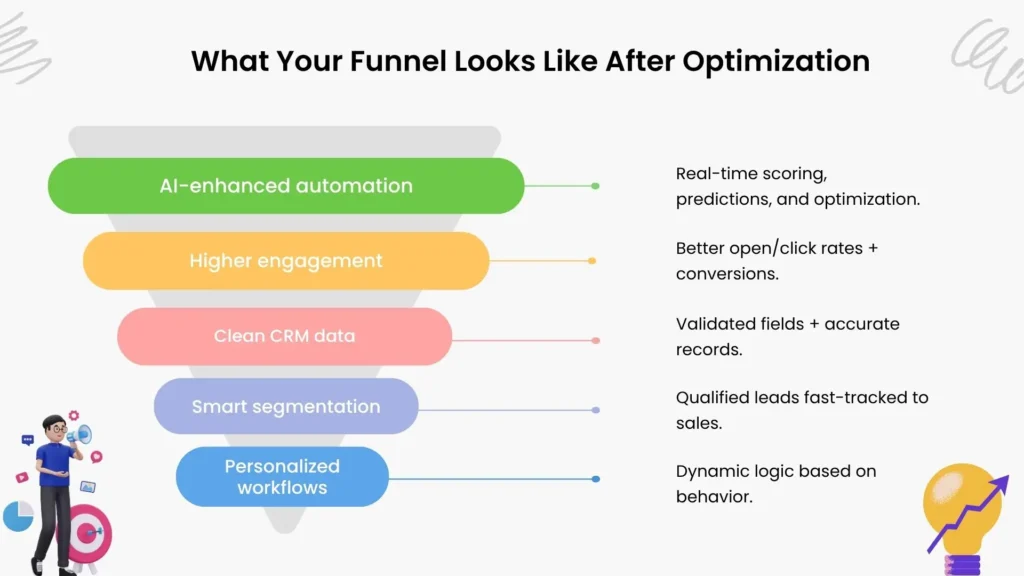
- Adopt AI-first segmentation & analytics: Use predictive models to group contacts by likely behavior, not just past actions.
- Build omnichannel orchestration: Don’t limit automation to email integrate with SMS, chatbots, social ads, and web journeys.
- Automate compliance & data governance: Use built-in triggers to flag and archive data that’s stale, or to enforce privacy policies.
- Set up a quarterly audit cadence: Every 3 months, run a “health check” on your automations data hygiene, workflow logic, performance metrics, and system integrations.
- Ensure flexibility: Use modular, no-code builders so that when business priorities shift, automation workflows can adapt without full rewrites.
These practices help you maintain momentum, avoid technical debt, and scale automation sustainably, especially when supported by expert marketing automation consultation or ongoing marketing automation services.
Conclusion
Marketing automation can be a game-changer, but only if you navigate the common marketing automation pitfalls. From misaligned strategy to messy data, overcomplicated workflows to underused AI, these automation errors can drain your budget and harm your lead pipeline. The good news is that most are fixable with systematic checks, smart tools, and a disciplined approach.
If you’re unsure whether your automation is underperforming or if you want to power up your lead flow consider getting an Automation Audit or Lead Flow Optimization Consultation. Sometimes an outside perspective catches what internal teams miss, and sets you up for long-term ROI.
FAQ’s
The biggest issues usually involve poor strategy alignment, weak segmentation, outdated data, generic email flows, and broken CRM sync. These mistakes lead to low engagement and lost leads.
Watch for sudden drops in open rates, duplicate contacts, leads getting stuck in workflows, or inconsistent data in your CRM. These are early warning signs.
A full review every quarter keeps workflows healthy. This includes checking data hygiene, CRM mapping, logic errors, and performance metrics.
Start by refining your lead scoring, fixing CRM sync problems, and personalizing your nurture sequences. Then add predictive analytics or AI-driven scoring for accuracy.
Yes, if the system matches their stage and goals. Even small setups benefit from simple workflows like welcome emails, follow-ups, and lead qualification.
AI helps with predictive scoring, behavior-based segmentation, content recommendations, and workflow optimization. It makes automation smarter instead of just faster.