Search is no longer just about ranking on Google.
People ask AI tools for answers. They scan AI Overviews. They get summaries without clicking. They compare brands before visiting websites. That shift has created a new challenge: traditional SEO alone is no longer enough.
This is where Total Search Optimization strategy comes in.
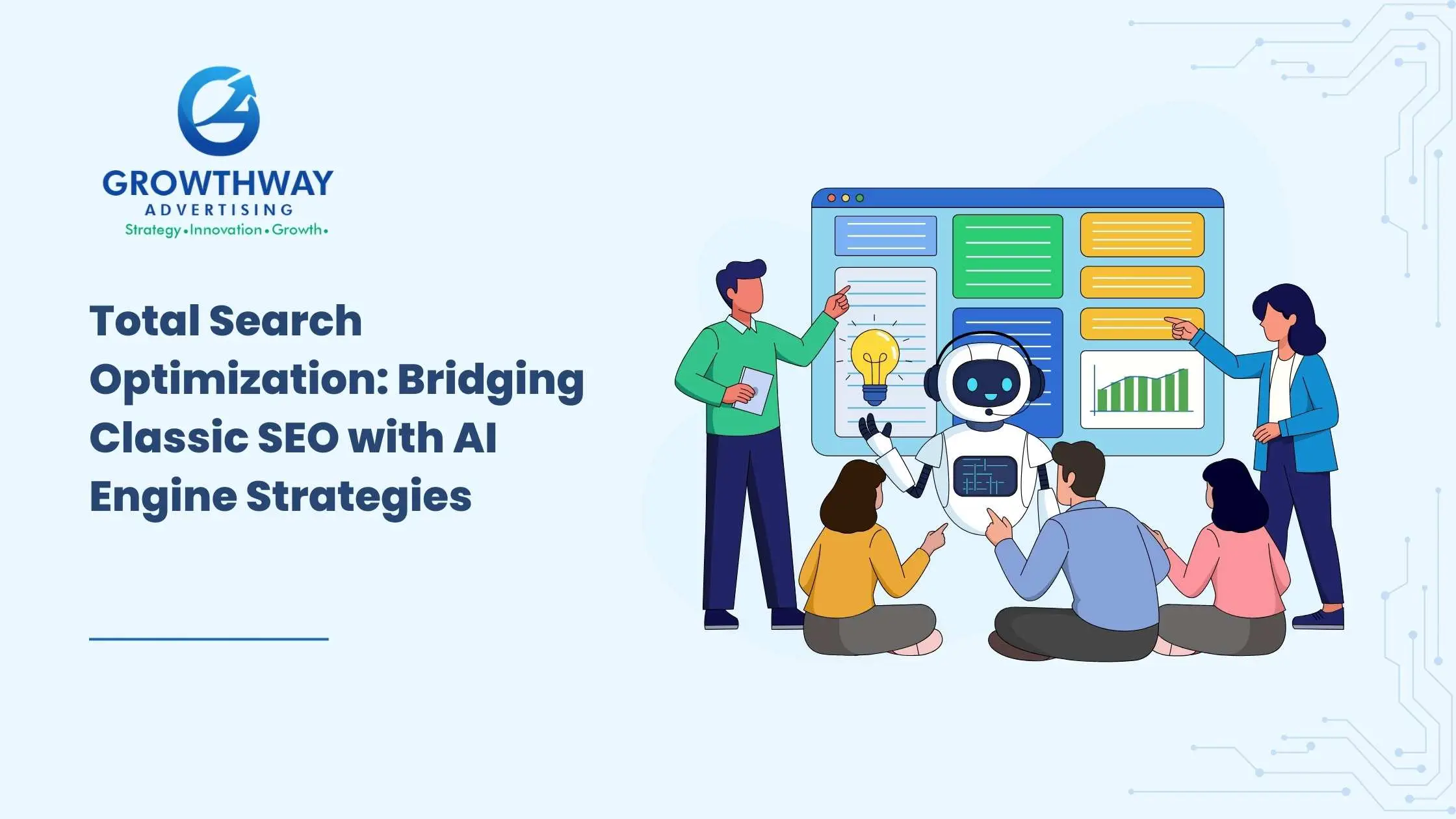
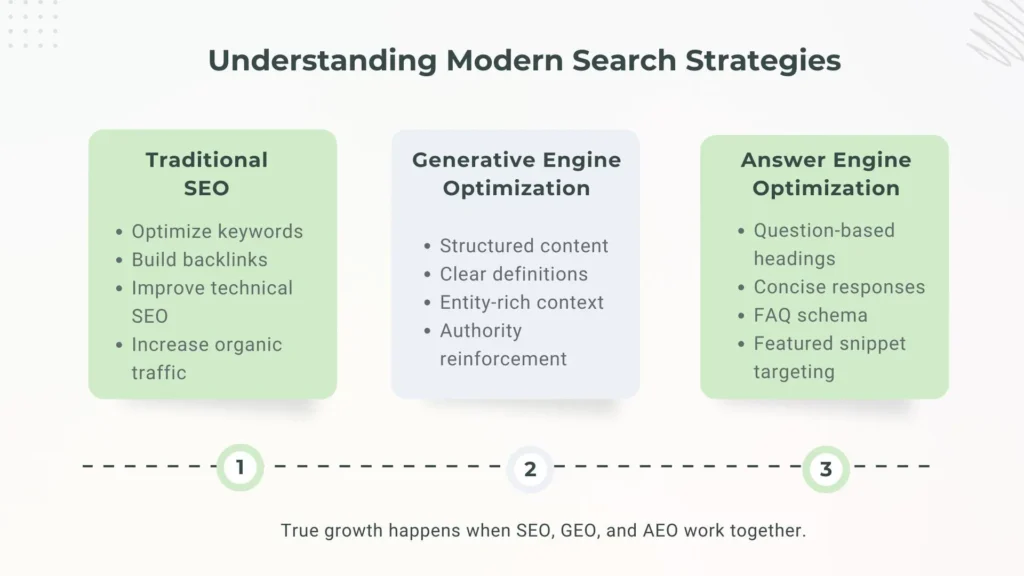
It’s the integration of traditional search engine optimization, generative engine optimization, and answer engine optimization into one cohesive visibility system. Instead of optimizing for one platform, you optimize for the entire search ecosystem. And that ecosystem now includes AI engines.
Why Traditional SEO Is Still the Foundation
Before jumping into AI strategy, let’s ground this properly.
Classic SEO still drives discoverability. Crawlers still index pages. Rankings still influence traffic. Authority still matters. But search engines are evolving into hybrid systems. They don’t just rank content. They summarize it, interpret it, and recombine it.
Understanding how AI affects SEO is critical here. AI doesn’t replace search. It reshapes how results are delivered. In a proper AI and traditional SEO comparison, the difference isn’t about competition. It’s about layers. SEO gets you indexed and ranked. AI engines decide whether your content gets cited and synthesized. That’s a big shift.
Traditional optimization focused on:
- Keywords
- Backlinks
- Technical performance
Total Search expands that to include context, clarity, extractability, and entity depth.
What Is Generative Engine Optimization and Why It Matters
Generative Engine Optimization focuses on increasing the likelihood that AI systems reference or cite your content when generating answers.
This is different from ranking #1.
Generative engines don’t show ten blue links. They analyze multiple sources and produce a synthesized response. Your job isn’t just to appear in search results. Your job is to become a trusted input.
That’s where effective generative engine optimization strategies come into play.
To optimize for generative AI, your content must:
- Clearly define concepts
- Use structured headings
- Avoid vague filler
- Provide factual depth
- Reinforce authority signals
If someone searches how to structure content for AI engines, the real answer lies in clarity and semantic precision. That’s what how to optimize content for generative AI truly means.
AI prefers content that is clean, contextual, and confidently written.
The Role of Answer Engine Optimization in Zero-Click Search
Answer engines don’t just display results. They provide direct responses. That’s why featured snippets, AI Overviews, and voice responses are becoming dominant.
Users increasingly get their answers without visiting websites. This is the era of what is zero-click search and it’s growing fast.
So how do you compete when users don’t click?
You design content that wins the answer box.
Strong AEO strategies for beginners often start with formatting:
- Clear question headers
- Direct answers immediately below
- Contextual expansion afterward
But advanced Answer Engine Optimization (AEO) goes deeper. It understands how conversational queries are evolving. People don’t just search for definitions anymore. They ask layered questions.
They want comparisons, examples, simplifications.
That’s why adapting to AI search behavior requires understanding how to adapt SEO strategy for AI search rather than just chasing keywords.
Search Intent Has Changed More Than Most Realize
Traditional SEO focused on informational, navigational, and transactional queries. AI search has added conversational and exploratory layers.
For example, instead of searching “entity SEO,” users might ask, “Explain entity SEO in simple terms and how it impacts AI search results.”
This subtle change forces deeper content structure.
Following AI search trends 2026, we see that AI-driven results prioritize clarity over cleverness. If your content buries the answer three paragraphs down, you reduce extraction probability.
That’s why Total Search Optimization emphasizes both structure and substance.
EEAT Is No Longer Optional
If you’ve wondered what EEAT is in SEO, here’s the simplified truth: it’s the backbone of trust in both traditional and AI-driven search.
Experience. Expertise. Authoritativeness. Trustworthiness.
AI systems are trained to identify reliable sources. If your brand lacks visible authority signals, citation frequency drops.
Understanding how to improve EEAT score involves:
- Publishing expert-level insights
- Showing real-world experience
- Maintaining author transparency
- Building consistent brand mentions
This directly connects to EEAT and brand trust signals, which influence how confidently AI engines reference your content.
Authority now affects not just rankings but inclusion in generated answers.
Entity-Based SEO and Knowledge Graph Signals
Let’s go deeper into something most blogs skim over.
If you’ve asked, what is entity optimization in SEO, the answer lies in how search engines understand relationships between concepts.
Search engines don’t just read keywords. They interpret entities and their connections.
For example, when discussing Total Search Optimization, related entities might include AI engines, structured data, user experience metrics, knowledge graphs, and brand authority.
Strong entity based SEO strategies involve building topic clusters that reinforce semantic relevance rather than isolated keyword pages.
Understanding how entities impact AI search results gives you a competitive edge. AI engines rely heavily on entity recognition when synthesizing answers. If your site consistently reinforces related concepts, your authority strengthens.
This is how you build durable topical authority instead of chasing temporary rankings.
Technical SEO for AI and Structured Interpretation
Technical SEO remains essential, but its purpose is expanding.
Many still ask how schema markup helps search ranking. Beyond rich snippets, schema supports structured interpretation. It reinforces context and relationships.
Applying structured data for AI search engines increases clarity signals. It tells machines exactly what your content represents.
This doesn’t guarantee citation. But it increases interpretability.
A modern technical SEO system must support:
- Logical heading hierarchy
- Internal linking aligned with entity clusters
- Clear metadata
- Fast performance
- Structured data implementation
When someone builds a technical SEO checklist for AI search, it should go beyond crawling and indexing. It should consider extractability and contextual reinforcement.
Search Experience Optimization as a Ranking Multiplier
Traffic alone is no longer the ultimate metric.
That’s why understanding search experience optimization is critical.
Search Experience Optimization connects SEO with behavioral performance. If users bounce quickly or struggle to navigate, trust signals weaken.
AI systems learn from engagement patterns across the web. Knowing how user experience affects search rankings helps you align content structure with human psychology. Instead of stuffing keywords, you create readable, logically structured, insight-rich content.
SXO bridges human satisfaction with algorithmic evaluation.
AI Citation Optimization: The Overlooked Advantage
One of the most powerful but least discussed aspects of Total Search Optimization is citation probability.
If someone searches how to rank content for AI answers, the answer isn’t simply backlinks or keyword density.
It’s clarity and authority density.
AI engines pull from content that:
- Defines terms clearly
- Avoids ambiguity
- Uses structured sections
- Provides factual backing
- Maintains neutral, confident tone
When you optimize for citation, you optimize for extractable insight.
This is where generative search optimization examples become powerful teaching tools internally. Brands that test formatting improvements often see increased visibility in AI summaries.
Measuring Visibility in the AI Era
A common question emerging is how to measure AI search visibility.
Traditional analytics tools track clicks. But AI-driven discovery requires broader thinking.
You must monitor:
- Brand mentions in AI summaries
- Featured snippet ownership
- Share of search visibility
- Entity association growth
- Impressions across zero-click placements
Total Search Optimization is not just traffic acquisition. It’s presence acquisition.
This reflects the evolving future of search optimization where brand recognition within AI ecosystems becomes as important as rankings.
Integrating SEO, GEO, and AEO into One Framework
Many discussions separate SEO and GEO, leading to confusion around the difference between SEO and GEO.
In reality, they’re layers of the same system.
SEO builds foundation and authority.
GEO increases citation probability.
AEO enhances answer visibility.
When unified, they create durable visibility.
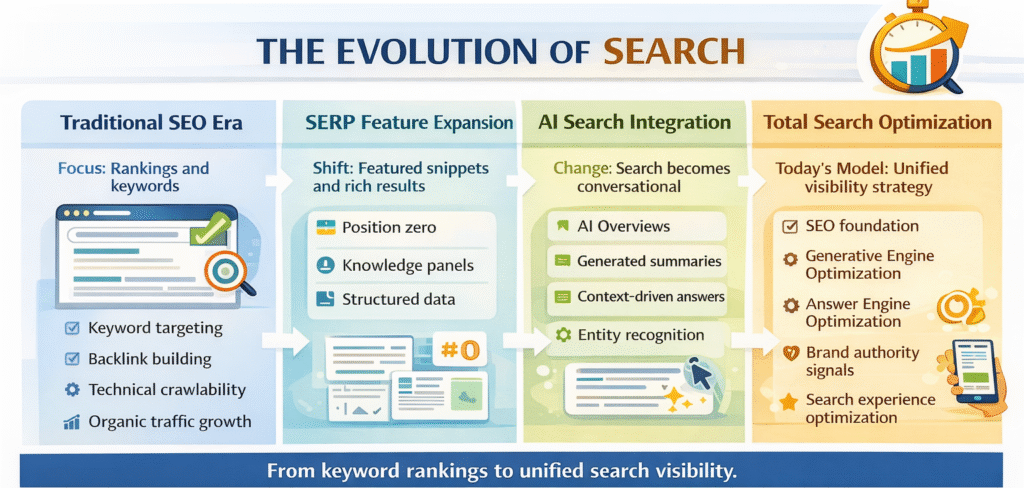
Instead of building isolated tactics, Total Search Optimization connects:
- Technical precision
- Structured clarity
- Conversational targeting
- Authority reinforcement
- Entity mapping
- Experience optimization
This is how brands adapt to AI search ranking factors 2026 without abandoning traditional SEO fundamentals.
Why Total Search Optimization Is the Strategic Shift
Search is no longer linear.
Users interact with information through layered AI systems. They compare summaries, skim generated insights, and trust authority patterns more than ranking positions alone.
If you only focus on keywords, you miss entity relevance.
If you only chase rankings, you miss citations.
If you ignore UX, you weaken trust.
If you ignore authority, you reduce inclusion probability.
Total Search Optimization bridges all of it.
It answers the real question marketers are asking: how do we stay visible when search engines are evolving into intelligent answer systems?
The answer lies in integrating classic SEO with AI engine strategies, aligning technical foundations with conversational structure, and reinforcing authority across the web.
Visibility now belongs to brands that are structured, credible, contextual, and extractable.
FAQ’s
Generative Engine Optimization is the practice of structuring and optimizing content so AI systems can easily extract, understand, and cite it in generated responses.
Answer Engine Optimization focuses on formatting content to win featured snippets, AI summaries, and direct answer placements in search results.
AI search can reduce clicks due to zero-click answers, but it increases brand exposure. Businesses must optimize for visibility and citations, not just traffic.
To optimize for AI engines, create structured content with clear headings, concise answers, entity-rich context, strong authority signals, and proper schema markup.
Zero-click searches occur when users get answers directly on the search results page. Optimizing for them improves brand visibility even without website visits.
EEAT helps establish trust. AI systems prioritize content that demonstrates experience, expertise, authority, and credibility when generating answers.