Here’s the thing. Most businesses don’t lose money on ads because PPC doesn’t work. They lose money because the budget was set blindly, managed emotionally, and scaled without a system.
If you want paid ads to grow revenue instead of draining it, budgeting has to be strategic, not hopeful. Let’s break down how smart brands, and any experienced ppc agency, actually set and manage PPC budgets without waste.
Start With the Business Reality, Not the Platform
The biggest mistake is opening Google Ads and deciding a number that feels comfortable.
A smart PPC budget starts outside the ad platform.
Ask:
- How much can you afford to spend to acquire one customer?
- How long does it take to recover that cost?
- Is PPC meant to drive immediate sales, qualified leads, or pipeline growth?
Until these answers are clear, even the best ppc services won’t save the budget.
This is where real PPC budget strategy begins: aligning spend with cash flow, margins, and growth stage.
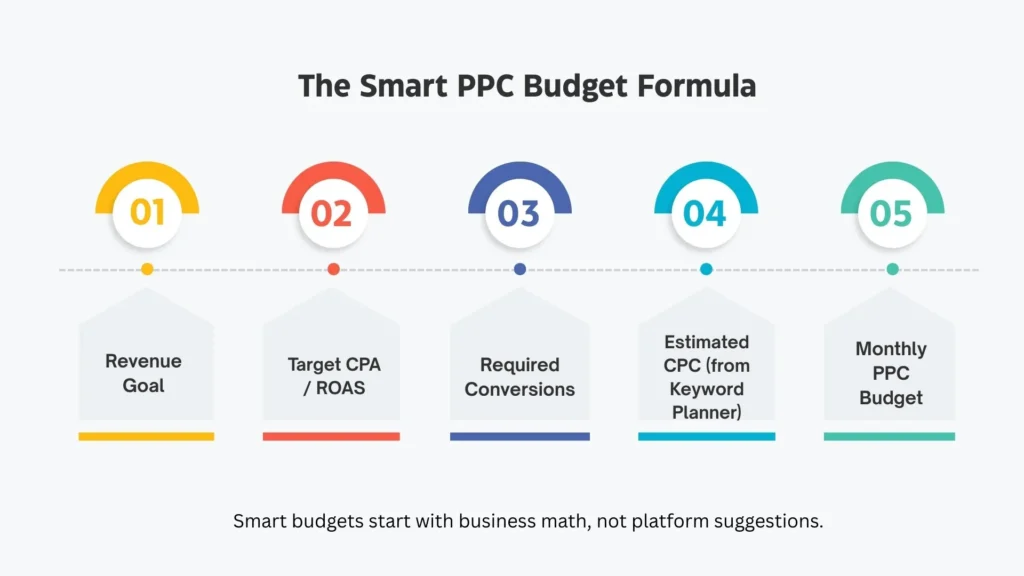
Reverse-Engineer Your PPC Budget From Numbers That Matter
Instead of asking “how much should I spend,” ask “how many conversions do I need.”
Work backwards:
- Revenue goal
- Average conversion value
- Target CPA or ROAS
- Required number of conversions
- Estimated cost per click
This simple logic is missing in most guides, yet it’s what separates controlled growth from random spending.
Tools like Keyword Planner help estimate CPC ranges, but they should guide expectations, not dictate the budget.
Budget Allocation Strategy: Don’t Treat All Clicks Equally
One of the most ignored topics in PPC budgeting is intent.
Not all clicks deserve the same money.
A smart budget allocation strategy splits spend by funnel stage:
- High-intent keywords get the largest share
- Mid-funnel campaigns support consideration
- Awareness campaigns stay capped and controlled
Most ppc advertising companies overspend at the top of the funnel without a clear path to conversion. That’s how budgets disappear without results.
Low Budget PPC Strategy That Actually Works
Small budgets don’t mean small thinking.
A smart low budget PPC strategy focuses on:
- Fewer campaigns
- Fewer keywords
- Higher intent
- Tighter targeting
Instead of spreading money thin, concentrate on where the conversion probability is highest. This is where experienced ppc marketing services outperform generic setups.
Low budgets should buy learning and profitability, not exposure.
Smart Bidding Is Not a Set-and-Forget Switch
Platforms push automation hard, but Smart Bidding without guardrails is one of the biggest budget killers.
Smart bidding works best when:
- Conversion tracking is accurate
- There is enough data
- Budgets are stable, not constantly changing
Without this, automation amplifies mistakes faster than manual bidding ever could.
That’s why smart advertisers combine Smart Bidding with limits, monitoring, and fallback rules.
Automated Budget Control Beats Manual Guesswork
Manual budget changes react to the past. Smart systems prepare for the future.
Automated budget control helps:
- Pause overspending campaigns automatically
- Shift budget to high-performing ad groups
- Protect spend during low-conversion periods
Using rule-based optimization, you can define clear actions like:
- Reduce bids if CPA crosses a threshold
- Increase budget only after consistent performance
- Pause keywords draining spend without conversions
This is where PPC Automation becomes a safety net, not a risk.
Avoid Overspending by Fixing These Hidden Leaks
Most guides talk about negatives and targeting. That’s surface-level.
Real overspending happens due to:
- Broken conversion tracking
- Too many campaigns competing for the same keywords
- Broad match without controls
- Learning phase resets from frequent changes
To avoid overspending, audits must go beyond keywords into structure, tracking, and bidding behavior.
This is where a seasoned pay per click advertising firm adds real value.
Optimize Bid Strategies Based on Data, Not Emotion
One bad week doesn’t mean a campaign is broken. One good day doesn’t mean it’s scalable.
Smart teams Optimize Bid Strategies using:
- Rolling averages, not daily spikes
- Conversion lag data
- Performance by device, location, and time
Budgets fail when decisions are emotional. They succeed when decisions are statistical.
PPC Budget Management Is an Ongoing System, Not a Task
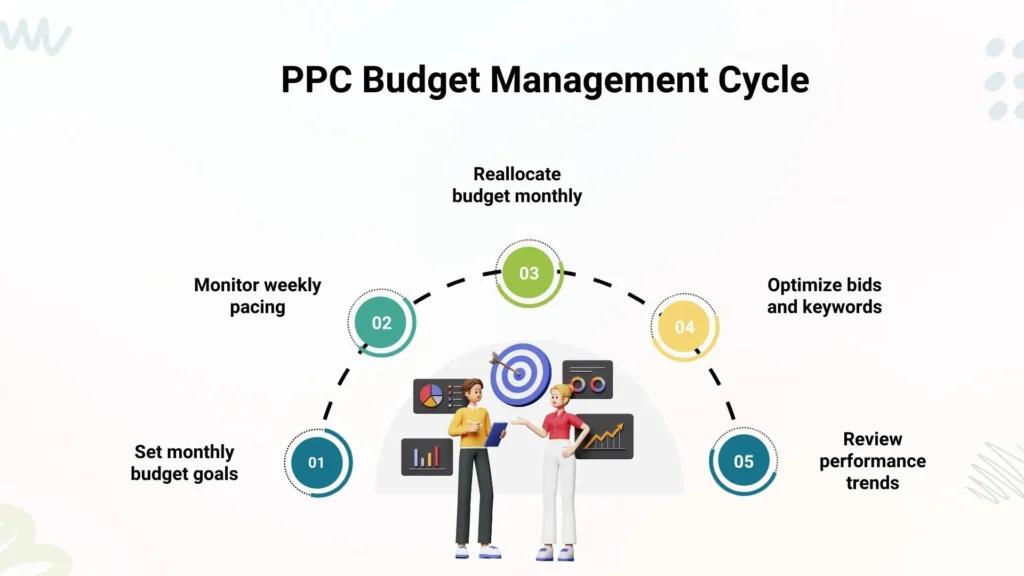
Effective PPC budget management means:
- Weekly pacing reviews
- Monthly reallocation
- Quarterly strategy resets
It’s not about spending less. It’s about spending intentionally.
Good ppc services don’t promise lower spend. They promise controlled growth.
Cross-Channel PPC Strategy: Stop Budgeting in Silos
One of the biggest gaps in most PPC blogs is cross-channel thinking.
A smart cross-channel PPC strategy asks:
- Should the budget move from Search to Display?
- Is YouTube assisting conversions even if it’s not last-click?
- Should PPC scale down when SEO traffic grows?
To Optimize Budgets across platforms, you need unified reporting and shared goals. Otherwise, channels compete instead of supporting each other.
Testing vs Scaling: Separate the Budgets
Another commonly missed concept.
Testing and scaling should never share the same budget pool.
Smart advertisers:
- Allocate a fixed percentage for testing
- Protect winning campaigns from test volatility
- Kill tests quickly if data doesn’t justify spend
This discipline is what keeps ppc advertising companies profitable long-term.
PPC Automation With Human Oversight Wins
Automation is powerful. Blind automation is dangerous.
The smartest setups combine:
- PPC Automation for efficiency
- Human oversight for strategy
- rule-based optimization for control
Automation should execute decisions, not make them blindly.
When Increasing Budget Is a Mistake
More spend doesn’t always mean more results.
Do not increase budgets if:
- Conversion rates are unstable
- Tracking is unreliable
- Campaigns are still in learning
- CPA is rising faster than volume
A smart PPC budget strategy knows when to hold back as much as when to scale.
What Smart PPC Budgeting Really Looks Like
It’s not about finding the perfect number.
It’s about:
- Clear goals
- Structured allocation
- Controlled automation
- Cross-platform thinking
- Continuous optimization
That’s why experienced ppc agency teams focus less on ad spend and more on decision systems.
Because when the system is right, the budget stops leaking and starts compounding.
FAQ’s
The smart way is to work backward from business goals, not platform suggestions. Start with target CPA or ROAS, then calculate how much spend is needed to reach those numbers without risking cash flow.
There’s no fixed amount. A small business should spend only what it can recover profitably, focusing on high-intent keywords and controlled testing rather than broad reach.
You avoid waste by tightening keyword intent, fixing conversion tracking, using budget caps, and applying automated rules to stop underperforming campaigns early.
Monthly budgets offer better control. Daily budgets are useful for pacing, but long-term planning should always be done at the monthly level to avoid overspending.
Most of the budget should go to high-intent, conversion-focused campaigns. Testing and awareness campaigns should have smaller, protected allocations.
Budgets should be reviewed weekly for pacing and monthly for strategic changes. Avoid making frequent changes that reset learning and disrupt performance.