Search has changed faster in the last two years than it did in the previous decade.
People aren’t just typing keywords and clicking links anymore. Now, they ask full questions, expect quick summaries, and interact with AI-generated answers right in the search results.
That shift is where Generative Engine Optimization comes in.
If you’re experienced with traditional SEO, know that GEO doesn’t replace it. Instead, it builds on it. GEO helps you stay visible when AI, not just search engines, decides what content appears.
Let’s take a closer look.
What Is Generative Engine Optimization
Generative Engine Optimization (GEO) means making your content easy for AI-powered search systems and generative models to find, understand, and reference.
Instead of optimizing only for rankings, GEO focuses on:
- Appearing in AI-generated answers
- Becoming part of conversational search results
- Increasing visibility in AI search engines
- Structuring content for large language models
Traditional SEO asks:
How do I rank on page one?
GEO asks:
How do I become the source AI trusts and summarizes?
That shift changes everything.
Why GEO Matters Now
Search platforms are integrating AI summaries, conversational results, and instant answer panels. Users often get what they need without clicking ten links.
This is the era of:
- AI overviews
- Zero-click searches
- Answer engine optimization
- Search generative experience
If your content isn’t set up for these systems, you might still rank, but you won’t show up in AI-generated results.
What this really means is visibility now has two layers:
- Traditional SERP ranking
- AI answer inclusion
You need to focus on both areas.
How Generative Search Actually Works
To optimize correctly, you need to understand how generative systems choose content.
AI models:
- Crawl and analyze web content.
- Identify semantic meaning, not just keywords.
- Evaluate clarity and authority.
- Pull structured insights to generate summarized answers.
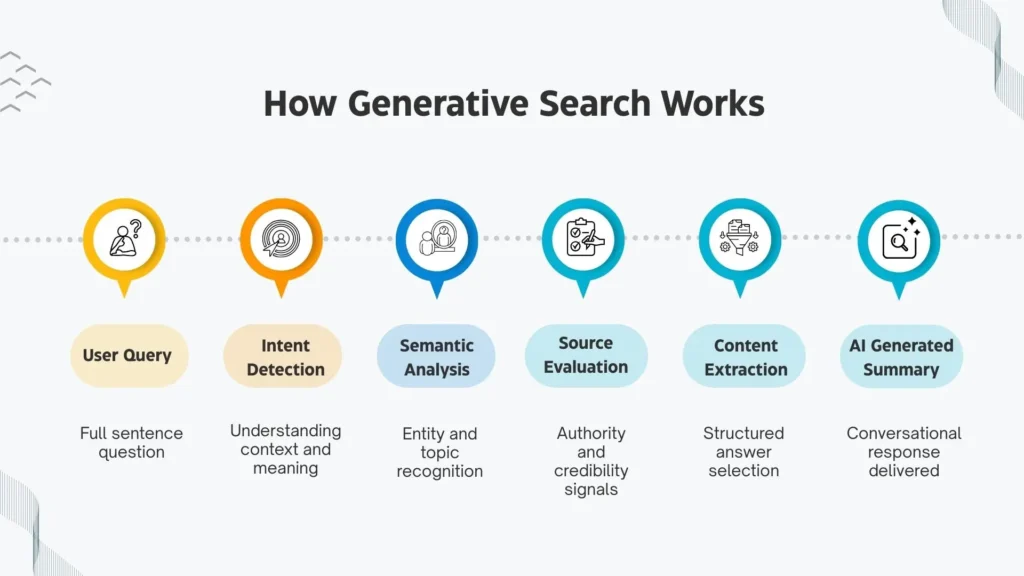
This is driven by:
- Natural language processing
- Semantic search
- Entity-based SEO
- Contextual relevance
If your content is unclear, packed with keywords, or not well organized, AI systems will struggle to pull useful information from it. Clear writing is more effective than trying to be clever.
GEO vs Traditional SEO
Let’s compare the mindset shift.
Traditional SEO focuses on:
- Keyword density
- Backlinks
- Technical crawlability
- Meta tags
GEO expands into:
- Structured, extractable answers
- Clear topic clusters
- Context-rich explanations
- Trust signals
You still need technical SEO. You still need backlinks. But GEO prioritizes:
- Content optimization for AI
- Information architecture
- Search intent alignment
- Knowledge graph integration
It’s less about ranking for one keyword and more about becoming a trusted topical authority.
Core Pillars of Generative Engine Optimization
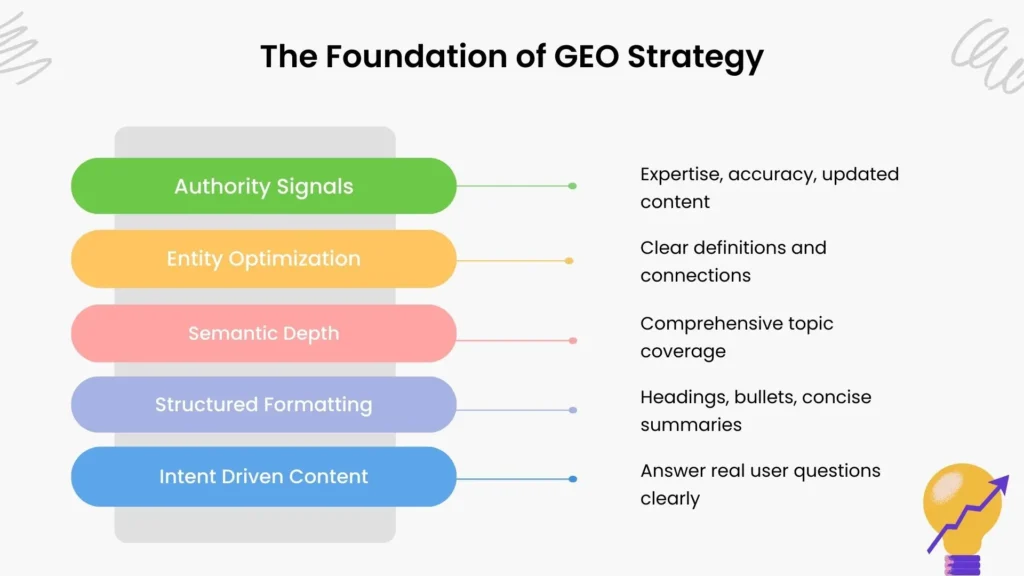
1. Intent-Driven Content
AI systems respond to intent, not just keywords.
Your content must address:
- Informational queries
- Comparative queries
- Transactional intent
- Problem-solving questions
That means building content around real user questions using:
- Search intent analysis
- User query mapping
- Long-tail keywords
- Conversational queries
If people are asking full-sentence questions, your content should answer them directly.
2. Structured and Scannable Formatting
AI models extract information more easily when content is structured clearly.
Use:
- Clear H2 and H3 hierarchy
- Bullet points for processes
- Short paragraphs
- Direct answers before deep explanations
This improves:
- Content discoverability
- Featured snippet optimization
- AI answer inclusion
Treat your content like building blocks. Each part should work on its own as a helpful answer.
3. Semantic Depth and Topical Authority
Thin content doesn’t survive in generative search.
You need:
- Related subtopics
- Supporting definitions
- Context expansion
- Internal linking structure
This builds:
- Topical authority
- Content relevance
- Search visibility
- Entity recognition
AI systems favor content that explains a topic in depth, not just with brief overviews.
4. Entity Optimization
Modern search relies heavily on entities.
Entities are people, brands, concepts, products, locations. When your content clearly defines and connects entities, you strengthen:
- Knowledge graph signals
- Semantic SEO
- Contextual alignment
This involves clearly naming and defining concepts, and linking them together throughout your content.
5. Trust and Authority Signals
Generative models prioritize credible sources.
To improve authority:
- Add author expertise
- Include credible references
- Maintain updated content
- Ensure factual accuracy
This supports:
- E-E-A-T principles
- Content authority
- Information accuracy
- Brand credibility
AI systems are designed to reduce misinformation. Authority matters more than ever.
How to Optimize Content for AI Overviews
Many marketers ask: how do we get into AI summaries?
Here’s the practical approach.
Provide Direct Answers Early
Begin each section with a short, clear explanation before adding details. AI systems usually pull from these early summaries.
Use Question-Based Subheadings
Structure headings like real user queries:
- What is generative engine optimization
- How does generative search work
- Why is GEO important
This aligns with voice search optimization and conversational patterns.
Add Contextual Examples
AI models prefer context-rich explanations rather than abstract definitions.
Keep Language Clear
Avoid jargon-heavy writing. Clear explanations improve:
- Content extraction
- AI summarization
- Search result inclusion
Clear writing makes it easier for machines to read and understand your content.
The Role of Technical SEO in GEO
Some people think GEO eliminates technical SEO. That’s not accurate.
You still need:
- Clean site structure
- Fast loading speeds
- Mobile optimization
- Schema markup
Schema plays a big role in:
- Structured data optimization
- Rich results visibility
- Search engine indexing
A strong technical setup helps generative systems find and understand your content.
Measuring GEO Performance
Traditional SEO looks at:
- Rankings
- Organic traffic
- Click-through rate
GEO measurement expands into:
- Visibility in AI summaries
- Brand mentions in generative responses
- Growth in branded searches
- Assisted conversions
Track:
- Impressions from informational queries
- Engagement metrics
- Content interaction depth
This supports better search performance analysis and organic growth strategy.
Content Strategy for Generative Visibility
Let’s shift from tactics to strategy.
A strong GEO strategy includes:
- Topic clustering around core themes
- Deep pillar content
- Supporting educational resources
- Regular content refresh cycles
This enhances:
- Search engine growth
- Organic search strategy
- Content ecosystem development
Instead of publishing isolated articles, build interconnected authority.
Common GEO Mistakes to Avoid
Many businesses misunderstand generative optimization.
Here are frequent errors:
Writing for Algorithms Instead of Users
If your content isn’t truly helpful, AI systems won’t highlight it for long.
Ignoring Context
Surface-level answers, lacking depth, weaken semantic relevance.
Overusing Keywords
Using too many keywords makes your writing less clear. Focus on what your content means, not just repeating words.
Skipping Updates
Outdated information reduces trust signals.
GEO favors content that is accurate and relevant.
The Relationship Between GEO, AEO, and SEO
You’ll often hear:
- SEO (Search Engine Optimization)
- AEO (Answer Engine Optimization)
- GEO (Generative Engine Optimization)
Here’s how they connect.
SEO improves ranking.
AEO improves featured snippet and direct answer visibility.
GEO improves AI-generated answer inclusion.
These strategies work together, rather than against each other.
Together they strengthen:
- Digital visibility
- Search experience optimization
- Organic discovery
If you skip one, your whole approach becomes less effective.
Future Trends in Generative Search
Generative search will likely continue evolving toward:
- Real-time personalized responses
- Multimodal answers combining text and visuals
- Deeper integration with voice assistants
- AI-driven content summarization
Brands that adapt early build durable authority.
Building a GEO-Ready Content Workflow
If you’re building this into your marketing process, here’s a simple framework.
Step 1: Intent Mapping
Identify informational, comparative, and problem-based queries.
Step 2: Content Structuring
Design outlines optimized for clarity and extraction.
Step 3: Semantic Expansion
Add related subtopics and entity connections.
Step 4: Technical Alignment
Implement schema and improve crawlability.
Step 5: Performance Monitoring
Track impressions, engagement, and generative mentions.
This structured workflow supports long-term organic search growth and stronger AI search optimization.
Why Businesses Can’t Ignore GEO
Search behavior is evolving toward dialogue. Users trust summarized answers. Brands that appear in those summaries gain disproportionate credibility. If your competitors are optimized for generative engines and you are not, they will shape the narrative in your industry.
Visibility is no longer just about ranking first. It’s about being the source AI systems choose to represent your category.
That’s the real shift behind Generative Engine Optimization.
FAQ’s
Traditional SEO focuses on rankings and keywords, while GEO focuses on getting included in AI-generated answers, conversational search results, and generative summaries alongside organic rankings.
As AI overviews and conversational search grow, brands that appear in generative responses gain higher trust, authority, and visibility even without users clicking through multiple links.
AI systems evaluate search intent, semantic relevance, topical authority, structured formatting, and credibility signals before extracting information for generated answers.
Yes. Structured data improves crawlability and context clarity, making it easier for search engines and AI systems to interpret and surface your content accurately.
Focus on question-based headings, concise answer sections, semantic depth, entity clarity, and aligning content with conversational queries and real user intent.
No. GEO expands on SEO. You still need technical SEO and backlinks, but you also need content optimized for AI-generated responses and answer engines.