The era of optimizing for AI search engines has begun. Google’s Search Generative Experience (SGE), Bing Copilot, Perplexity, ChatGPT, and Gemini have fundamentally changed how users discover information online. Traditional SEO built around keyword rankings and backlinks is no longer enough.
In 2025, ranking means being chosen by AI, not just indexed by Google. Developers, technical SEOs, and content strategists now share a common challenge: adapting their websites and content structures so AI systems can interpret, summarize, and recommend them.
The new game isn’t about who ranks higher, it’s about who becomes the trusted source that AI engines cite in their answers.
How AI Search Engines Interpret Content
Here’s the thing: AI-first SEO isn’t about tricking an algorithm. It’s about teaching it.
AI search engines don’t rely solely on keyword matching. They use semantic understanding, entity-based search, and retrieval-augmented generation (RAG) to decide what to show. Instead of simply scanning for words, they interpret meaning and context.
Semantic Understanding
Large Language Models (LLMs) like GPT-5 or Gemini analyze content conceptually. They build knowledge graphs around entities, people, technologies, companies, and concepts and link them through relationships. For example, if your documentation mentions “React” and “Next.js,” the AI connects those entities as part of a broader framework ecosystem.
Entity-Based Search
Google’s Knowledge Graph and Bing’s Linked Data Graph feed directly into AI answers. Structured data, such as JSON-LD markup or schema.org annotations, helps these models recognize your site as an authoritative source. This makes Optimize Structured Data a key ranking factor for AI content visibility.
Retrieval-Augmented Generation (RAG)
AI engines retrieve relevant information from external sources before generating answers. For instance, SGE may pull concise code examples from your developer docs and include them in its generated overview. If your documentation uses structured formatting (like <pre> tags for code or Markdown syntax for sections), it becomes easier for AI to extract.
Example:
When a user searches “how to implement OAuth 2.0 in Python,” SGE may extract a snippet from your documentation if it’s well-formatted, includes FAQPage schema, and answers the query directly.
This is where optimizing for AI search engines begins structuring your content so AI can find and trust it.
Technical Architecture Adjustments for AI Visibility
Developers have a unique advantage: they can shape a website’s architecture for both human and AI consumption. Here’s what matters most in the new AI-first SEO world.
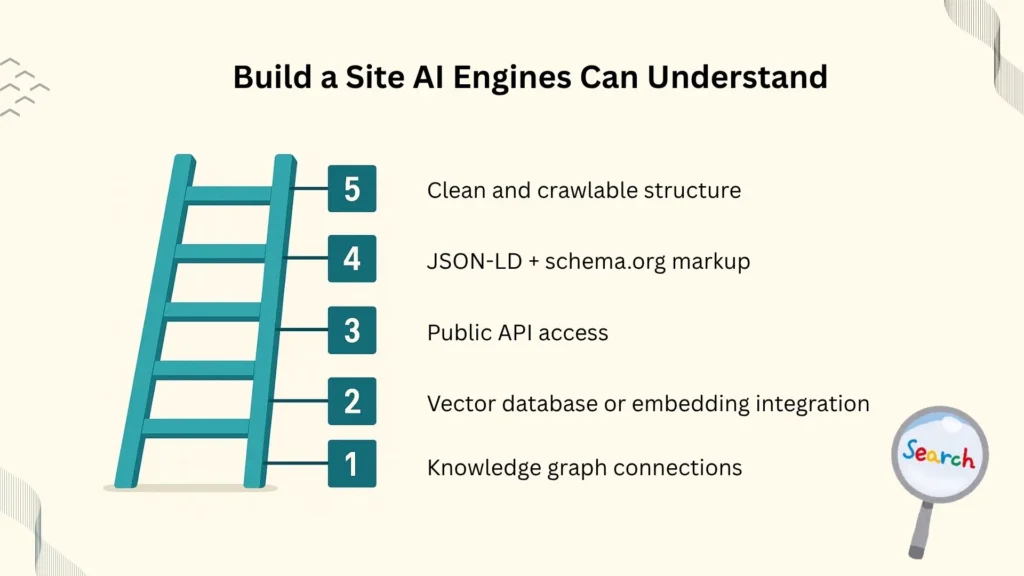
1. Clean, Crawlable Structure
AI systems still rely on foundational web data. A well-organized architecture with XML sitemaps, canonical tags, and optimized internal linking helps ensure full visibility. Keep URL structures short and descriptive (/nodejs-async-guide is better than /article?id=123).
2. Structured Markup and Schema
Implement JSON-LD with relevant schema.org types. AI engines depend on structured markup to identify what each page represents. Examples include:
- SoftwareSourceCode for repositories
- FAQPage for documentation
- HowTo for setup or installation guides
- Dataset for open data APIs
Use the about and mentions fields in schema to create semantic relationships between topics, helping AI understand context.
3. Expose API Access and Embeddings
Some AI engines like Perplexity or Bing Copilot may use public APIs to verify data freshness or pull real-time context. Make sure your APIs are accessible and documented.
Integrating vector databases or embedding layers (like Pinecone or Weaviate) into your architecture can make your internal knowledge base queryable by AI systems, both for internal search and future external integrations.
4. Knowledge Graph Integration
If your company has structured relationships, projects, services, authors, partners represent them using graph data. AI models consume relational context to understand authority. Connecting your web development services to named entities (like React, WordPress, or Shopify) strengthens thematic relevance.
What this really means is: LLMs don’t index keywords, they index meaning. So your codebase, documentation, and metadata must express meaning consistently and semantically.
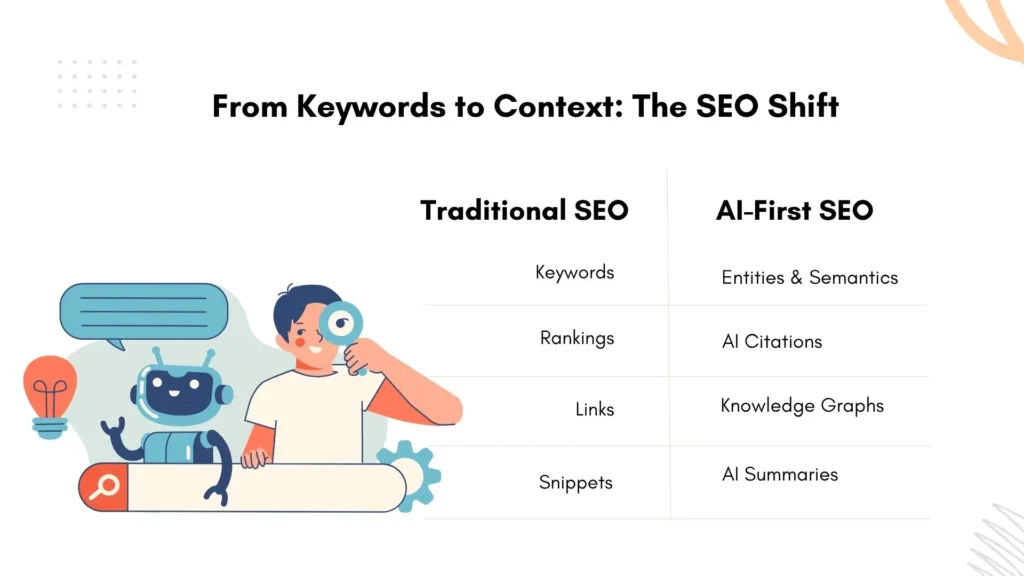
Content Optimization for AI Summaries
When optimizing for search generative experience 2025, you’re not writing for snippets you’re writing for synthesis. AI engines look for clear, factual, and modular content they can extract and rephrase into human-like summaries.
Here’s how to optimize your content for AI summaries:
1. Write Modular, Contextually Complete Sections
AI models prefer self-contained paragraphs. Each section should be understandable without scrolling through the entire page. Use structured subheadings (H2/H3) and focus each section on one core idea.
2. Include Q&A Segments
LLMs are trained on conversational data. Adding “Question-Answer” pairs throughout your content helps AI match your text to natural language queries.
Example:
Q: How do I optimize JSON-LD for AI search?
A: Keep your schema concise, validate with Google’s Rich Results Test, and align entities with known Knowledge Graph IDs.
3. Use Conversational and Declarative Phrasing
AI models extract content that mirrors how people ask questions. Blend natural language with technical precision. For instance, instead of “Developers should implement vector search,” write “To help AI engines understand your content, implement vector search through embeddings.”
4. Optimize for Featured Snippets and AI Overviews
While featured snippets were the goal in traditional SEO, they now feed directly into SGE and Bing Copilot answers.
To optimize:
- Place direct, one-sentence answers under each header.
- Use concise summaries within 50–60 words.
- Add schema markup for WebPage and Article types.
5. Write for Multimodal Context
With multimodal search results, AI engines interpret text, images, charts, and even audio. Add alt text to visuals and include descriptive captions like “Flowchart of OAuth 2.0 Authorization Flow.” This improves both accessibility and AI interpretation.
Developer Actions to Future-Proof Code and Content
To systematize this, here’s what we’ll call the AI Search Optimization Stack, a practical checklist for developers adapting to AI search.
Integrate Entity Tagging in Backend
Tag entities (frameworks, APIs, products) with schema metadata and link them to recognized Knowledge Graph entries.
Implement Content Embeddings
Use embedding models to make your internal search semantic. This improves contextual retrieval for both users and AI crawlers.
Monitor AI-Cited Results
Use tools like SGE Impression Tracking, AI SERP APIs, or browser extensions that show where your content appears in AI-generated answers.
Enable API Indexing
Offer structured APIs for your data and documentation. It allows AI crawlers to verify facts directly from your source.
Optimize Load Speed and Accessibility
AI systems often prioritize fast, stable, and mobile-responsive pages for inclusion in their datasets.
Adopt Voice and Multimodal Readiness
With AI search evolving into multimodal formats, ensure your site supports structured captions, alt text, and voice search optimization.
For example, use descriptive alt tags that reference entities, not just visuals “React dashboard UI built by web development agency Growthway” instead of “dashboard screenshot.”
Audit Semantic Consistency
Use schema validators and semantic crawlers (like Screaming Frog + RDF plugin) to ensure metadata matches on-page context.
Each of these steps strengthens the technical handshake between your website and AI systems turning your site into a trusted data source instead of just another webpage.
Measuring AI Search Performance
Tracking performance in an AI-driven ecosystem looks different. You’re not chasing blue links anymore, you’re measuring visibility in AI summaries.
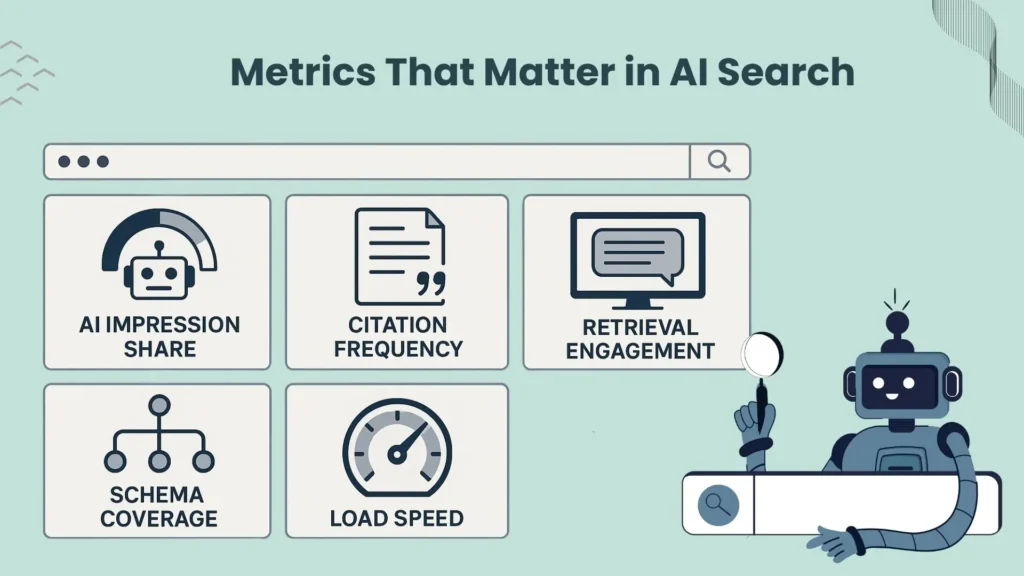
Here’s what to monitor in 2025:
1. AI Impression Share
This measures how often your content is cited or referenced in AI search summaries across Google SGE, Perplexity, or ChatGPT Search.
2. Retrieval Engagement
Analyze the context where your data is retrieved: are users clicking through from AI answers? Tools like AI SERP API or SGE Dashboard offer early insights into impression trends.
3. Citation Frequency and Source Attribution
Track how often your domain appears as a cited source in generative responses. Tools such as Perplexity Dashboard or Content Refiner can highlight these mentions.
4. AI Content Visibility
Go beyond traditional SEO metrics. Monitor structured data errors, schema coverage, and content embedding performance. Your technical stack now directly impacts AI content visibility.
5. Developer-Led KPIs
Since much of this overlaps with engineering, developers should track:
- Schema validation rates
- API response times for indexed endpoints
- Vector search accuracy for internal queries
- JSON-LD coverage ratios
The transition from page ranking to AI discovery introduces a new analytics mindset. You’re not optimizing for SERPs, you’re optimizing for AI retrieval and reasoning. For a web development agency, this shift means evolving beyond traditional SEO metrics to focus on how site architecture, structured data, and content quality influence AI-driven visibility. In short, your technical stack is now part of your search strategy.
Conclusion: Coding for Discoverability in the AI Era
Search is no longer about visibility, it’s about understandability. Developers are now co-architects of discoverability. As AI search engines continue to evolve, the line between web development and SEO is disappearing.
If you’re building digital platforms, your role extends beyond code. You’re defining how machines interpret knowledge.
Structured data, semantic markup, and factual, modular content form the foundation of this new web.
So whether you’re running a web development agency, managing technical SEO for SaaS, or scaling a web development company, the question isn’t how to rank higher, it’s how to be chosen by AI.
The future of discoverability belongs to developers who code with meaning.
FAQ’s
Optimizing for AI search engines means making your website understandable to AI systems like Google SGE, Bing Copilot, and Perplexity. Instead of focusing on keyword density, you prioritize structured data, factual clarity, and semantic context so AI models can accurately summarize or cite your content.
AI search engines interpret both code and content. A developer’s technical setup site speed, schema markup, and API accessibility directly affects AI discoverability.
SGE uses retrieval-augmented generation (RAG) and knowledge graphs to surface high-confidence, structured sources. Pages with strong schema, concise explanations, and verified entity relationships are more likely to be featured.
Structured data acts as a translator between your site and AI engines. JSON-LD and schema.org markup make it easier for models to interpret and retrieve your content accurately.
Clean site architecture, JSON-LD implementation, vector database integration, and embedding-based internal search systems all enhance AI discovery ranking and improve your site’s ability to be referenced by AI.