If you’ve ever used AI to write search ads, you’ve seen both sides. One moment you get clean, punchy lines. The next moment everything sounds the same. The trick isn’t avoiding AI. The trick is building a system where AI does the heavy lifting while humans shape the voice, emotion, and direction.
Most people search for things like how to test AI-generated ads, how to make copy sound less robotic, what prompts to use, or whether Google even allows AI-written ads. Let’s answer all of it in one place.
Why AI Matters More When You Have Volume
Human writers can deliver great lines, but they can’t produce 40 variations in five minutes. AI can. That speed is what transforms how ppc marketing services operate.
When you run multiple clients or large campaigns, you’re constantly refining ad variations, studying CTR patterns, tweaking CTAs, and rewriting messages for new angles. Generative models make this process constant rather than quarterly.
Here’s what this really means: AI isn’t replacing your writers. It’s giving you the freedom to test every angle you never had time to explore.
What Makes an AI Copy Feel “Human”?
Here’s the part many teams never talk about. AI doesn’t sound human by default. It sounds trained. If you want ads people trust, you focus on three things:
1. Context
Most weak ads happen because the prompt has no audience, no emotion, and no intent signals. When you give AI the right boundaries, the tone sharpens.
2. Specificity
Human writing feels grounded. Mention real benefits, outcomes, fears, or desires. AI needs these layers spelled out.
3. Structure
Don’t let AI produce the final copy in one step. Break it into stages. This is where AI workflows win.
Example:
- Generate core angles
- Pick the strongest hooks
- Regenerate shorter or sharper versions
- Convert to responsive search ads format
This is how copy stops sounding robotic and starts feeling intentionally crafted.
Advanced Prompt Structures That Actually Work
People often ask for the best chatgpt prompts for ad copy. The truth is the prompt changes depending on your goal. But the prompt pattern stays the same:
- Give the model your audience
- Give it your offer
- Tell it the emotional angle
- Tell it the constraints
- Tell it the optimization goal
This is how you get headlines and descriptions you can actually put into campaigns.
Try patterns like:
- “Generate 10 short benefit-focused angles that target first-time buyers who are comparing alternatives.”
- “Rewrite in a more conversational tone without losing clarity.”
- “Shorten this headline to fit RSA limits but keep the emotional hook.”
Simple. But it never fails.
The Gap Most Teams Miss: A/B Testing AI Variants
Here’s where things get interesting. Most marketers generate a bunch of ad variations, pick their favorites, and launch them. But you don’t know which one is objectively better.
When you use AI, your variation count increases dramatically, so your testing system needs to evolve too.
Here’s a simple framework any ppc company can use:
- Start with 20–30 AI-generated variations
- Group them by angle: emotional, functional, urgency, proof
- Launch 6–8 that cover each angle
- Identify the angle with the highest lift in CTR
- Generate a new batch only within that angle
- Keep shrinking until one angle dominates
This is how generative AI turns into a strategic engine instead of a copy machine.
Turning Performance Data Into Better Prompts
This is the secret missing from almost every conversation about AI. You shouldn’t just generate and test. You should feed learning back into your prompt system.
Here’s a real example of how this works:
- If emotional lines outperform functional lines → instruct the AI: “Prioritize emotional appeal in future angles.”
- If short headlines outperform long ones → update prompts: “Keep all headlines between 20–26 characters.”
- If question-style headlines tank → add: “Avoid question-based headlines.”
You create a living prompt that evolves based on what actually wins. Now your PPC optimization loop becomes real.
Building a Human-in-the-Loop Workflow
AI can generate hundreds of lines. But the brand can only run with a few of them. So you need three layers of review:
1. Brand Safety
Look for claims that may violate platform rules. AI sometimes exaggerates benefits, so tighten anything that sounds absolute.
2. Tone Alignment
Your human editors make sure the copy sounds conversational, clear, and intentional.
3. Compliance
Especially in niches like finance, health, or real estate. AI can write lines an advertiser legally cannot use.
The best ppc services teams implement a final 5-minute manual pass where an editor checks for tone, ethics, and accuracy.
When AI Ads Get Disapproved & How to Fix It
This is a common worry for many ppc advertising companies. AI isn’t banned. But it can create disapproved ads if:
- It uses exaggerated claims
- It repeats sensitive terms
- It writes unclear or misleading benefits
- It violates personalized ads policies
- It creates “too generic” headlines
The fix is simple: run every batch through a compliance filter AND a human check. Over time, your prompts will “learn” how to avoid these mistakes.
The Practical Role of AI in Responsive Search Ads
Google’s RSA format rewards similar ideas, phrased differently. This is where AI outperforms humans because it can produce variety without losing relevance.
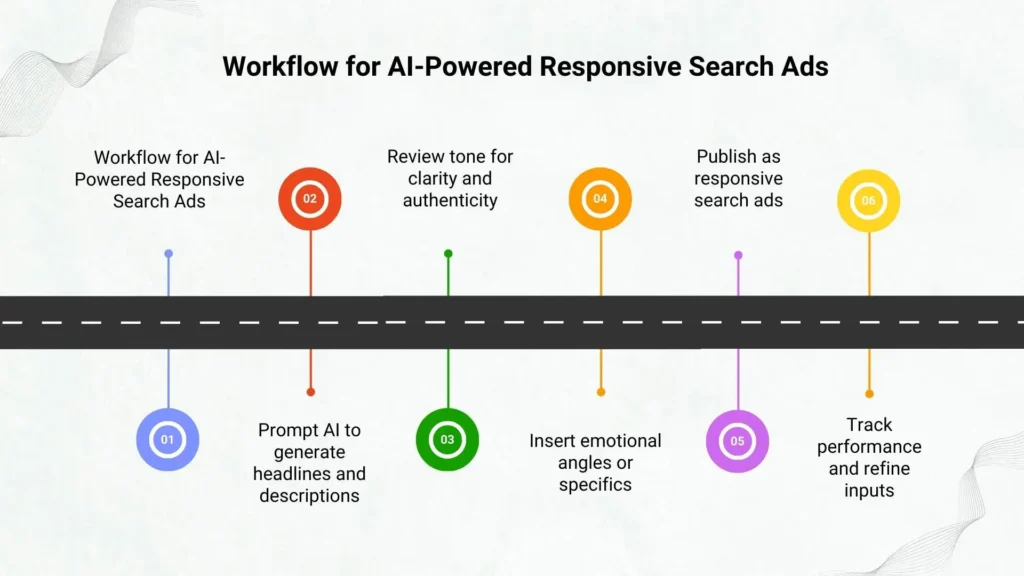
Use it to create:
- Short punchy benefits
- Value props
- Feature variants
- CTA alternates
- Trust-building lines
Just make sure every variant maps back to one message. Consistency beats creativity in RSA.
How AI Helps With Cross-Channel Ad Consistency
If you’re running search, display, and social together, consistency matters more than the style of each ad. AI helps by creating a master messaging direction, then adapting each variation for the channel.
Search wants clarity.
Social wants emotion.
Display wants hierarchy.
The video wants rhythm.
When AI handles the adaptation, your team stays focused on strategy, not rewriting.
Industry-Specific Prompts People Search For
This is where search demand spikes. People constantly look for AI prompts customized for industries like:
- SaaS
- eCommerce
- Real estate
- Healthcare
- Education
- Local service businesses
Each industry has different emotional triggers, objections, and benefit structures. When you build vertical prompt banks, your best ppc agency position becomes stronger because you turn AI into a repeatable system rather than a random experiment.
The Hidden Win: PPC Automation With AI
Most marketers think PPC automation means bidding. The future is creative automation.
AI can help you:
- Generate variations
- Rephrase lines for new audiences
- Translate ads while keeping tone
- Detect performance decay
- Suggest refresh cycles
- Flag underperforming angles
Combine that with ai ppc tools, and you start building campaigns that evolve weekly instead of quarterly.
Why AI Still Needs Human Direction
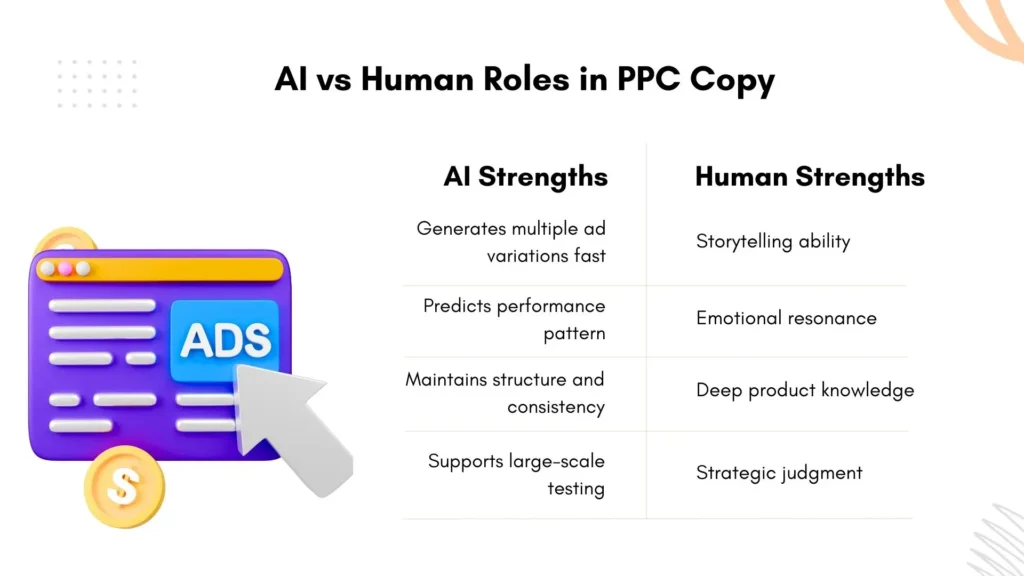
Even the best PPC automation doesn’t understand your business goals. Automation helps with speed. Humans decide what message earns trust.
Here’s the dynamic that works best:
AI = idea volume
Humans = judgment
Data = direction
When you merge the three, you get an ad copy that feels alive instead of algorithmic.
FAQ’s
Yes. AI can draft strong ideas, but the human tone comes from giving it clear context, emotional direction, and a structured prompt. The more specific the instructions, the more natural the copy feels.
It’s allowed. Google doesn’t ban AI content. You just need to avoid exaggerated claims, sensitive messaging, or anything that breaks ad policies. A quick human review solves this.
Start with 6–8 variations representing different angles like emotional, functional, or urgency-based. Once a winning angle emerges, generate new variants only within that style.
Provide audience pain points, real benefits, tone guidelines, and character limits. Add a human edit at the end to tighten the language and check brand voice.
Use AI to generate theme-based variations short benefits, value props, CTAs, and trust signals. Then mix and match them within RSA constraints for better coverage.
Structured prompts that include audience, offer, tone, constraints, and the goal work best. Asking for multiple angles (emotional, functional, urgency) also improves variety.