If you think of Instagram as simply a feed you scroll through, here’s what you’re missing: in 2025 it’s increasingly a search engine in its own right. According to recent research, people now use Instagram’s search bar and the Explore tab to find brands, services and inspiration, not just scroll mindlessly. At the same time, the Instagram algorithm is shifting to favour structured profiles, keyword relevance and contextual discovery. What this really means is that for your agency or brand, Instagram Search Optimization must become a strategic priority. If you optimize your profile, captions, content pillars and metadata correctly, you don’t just attract followers you become discoverable. Read on for how.
Understanding Instagram’s Evolving Search Algorithm
The landscape of how Instagram surfaces content has changed. Where hashtags and simple engagement once dominated discovery, Instagram Search Optimization now plays a central role, driven by three major shifts that are reshaping how visibility works on the platform:
1. Keyword-based indexing & contextual relevance
Instagram now processes the words in your username, name field, bio, captions, alt text, and post metadata to understand what your profile is about and which search queries it should surface for.
For example, if your name field says “Digital Marketing Agency | Social Media Services”, you’re signalling to Instagram you operate in that niche.
2. Engagement signals are still core but alongside search relevance
The algorithm in 2025 isn’t just: “lots of likes = many views.” It weighs saves, shares, comments (especially meaningful ones) and time spent viewing content.
Meta also underscores that search and discovery align with “signals” from accounts, hashtags and locations.
3. Discovery engine vs hashtag-feed engine
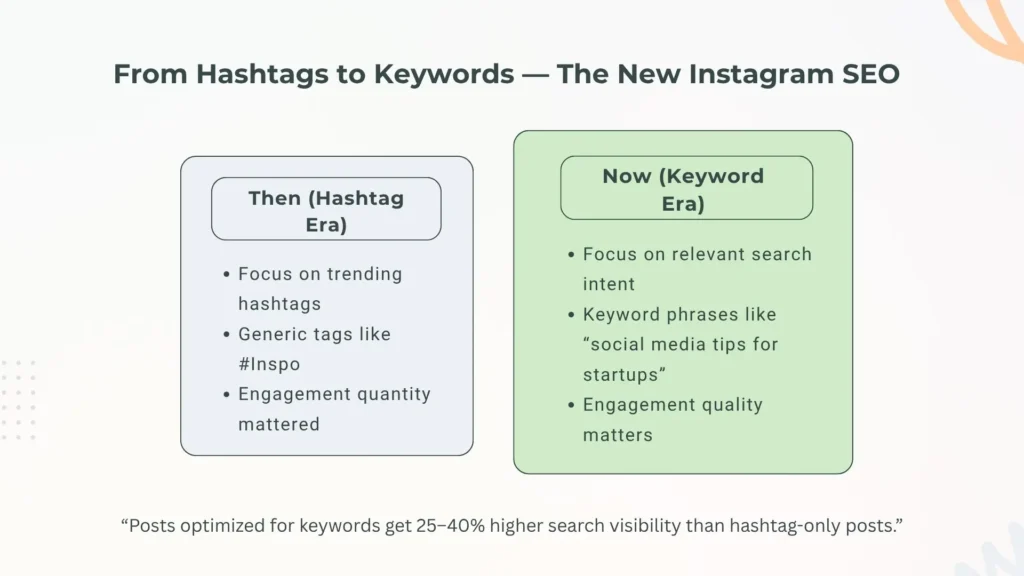
Hashtags matter less than before. While once the main path to discovery, the platform now emphasises broader contextual match, keyword-rich profiles, alt text and metadata.
In short: you’re optimising not for “#travelblog” alone, but for “travel tips”, “budget travel India”, “adventure travel gear” and making sure your profile and posts reflect those phrases naturally.
Core Elements of Instagram Search Optimization
Here’s how you turn your profile into a discovery-ready hub.
Profile name and handle optimisation
- Your handle (@username) should align with your brand and include keyword relevance if feasible.
- The Name field (bold text under your profile photo) is searchable. Including a core term like “Digital Marketing Agency” or “Social Media Marketing Services” helps.
- Ensure your category (e.g., “Marketing Agency”) is set correctly and your profile type is a Business/Creator account.
Bio keyword placement strategies
- In the first two lines of your bio: what you do + who you serve + primary keyword (for example: “We’re a social media advertising & social media marketing agency for small business growth”).
- Use one or two searchable phrases like social media services, Instagram marketing, social media advertising.
- Add a location if relevant to boost local searches.
Category tags and link features
- Use the category tag option to label yourself (e.g., Marketing Consultant, Advertising Agency).
- Include a link to a landing page that aligns with what users searching for your service might need (e.g., “Free Instagram Search Optimization Checklist”).
- Make sure the URL slug is simple and relevant.
Captions and alt-text keyword integration
- When you post, include keywords early in captions. Don’t stuff them; integrate naturally.
- Use the “Alt text” field for image description, it’s accessible and also picked up by Instagram’s algorithm.
- Hashtags still work, but consider them secondary to on-page keywords.
Turning Your Profile into a Discovery Hub
Now let’s orchestrate your content around search-friendly structure.
Step-by-step guide to structuring content pillars for search discoverability
- Identify 3-5 core pillars aligned with your brand + target keywords (e.g., Instagram Search Optimization, Social Media Advertising Tips, Website Development for SMBs).
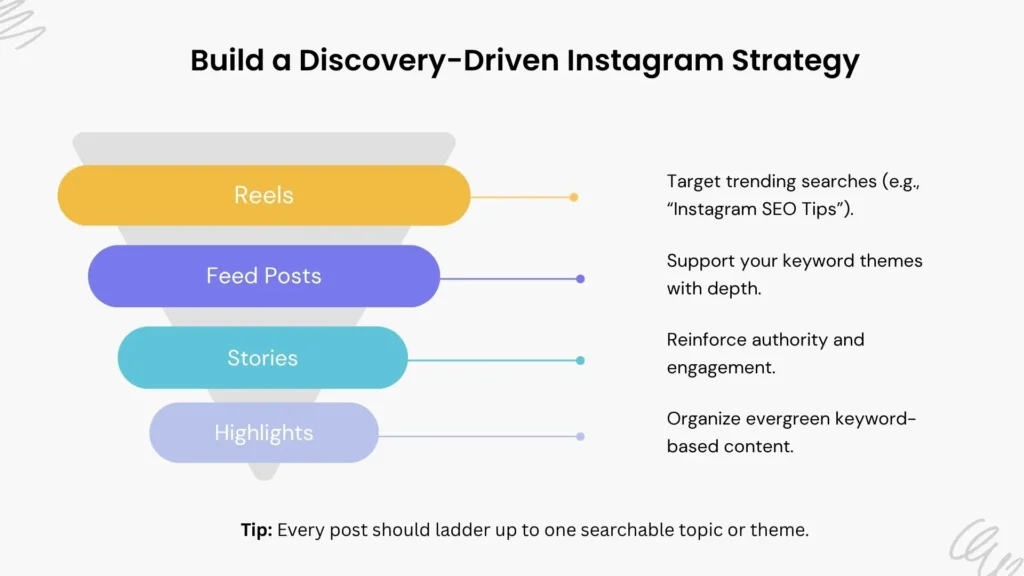
- Create content buckets: Reels, feed posts, Stories, Highlights each mapped to a pillar.
- For each piece, decide the target keyword/phrase (e.g., Instagram discoverability, profile SEO for Instagram, social media marketing agency tips) and incorporate it.
How to align Reels, Stories and Highlights around searchable topics
- Reels: Use popular search-friendly topics (e.g., “How to Optimize Instagram Profile for Search”) and ensure the title/first seconds include the keyword.
- Stories & Highlights: Create a Highlight called Discoverability Hub or Instagram SEO Tips where you store evergreen content. This makes your profile a mini resource when someone searches you.
- Feed posts: Mix content types carousel infographics, text-overlay visuals, short videos but always include descriptive captions and alt text.
Using AI captions and search-optimized metadata
- Use AI tools to generate caption ideas and ensure keywords are placed naturally.
- Make sure each image/video has alt text with 1–2 keywords and a user-friendly description.
- Monitor trending search queries (tools like Google Trends or Instagram search suggestions) and adapt your metadata accordingly.
Content Strategy Backed by Data
What makes this actionable is evidence from recent industry reports.
Insights from 2025 industry tools
- According to Later: “Optimising your Instagram for search … is one of the best ways to keep your account discoverable.”
- As noted by SEO Sherpa: “Instagram is now a search engine, not just a social platform.”
- One article reports that search behaviour on Instagram is so strong that public posts may now be indexed by external search engines like Google.
Example of brands improving discovery visibility through Instagram SEO
While individual brand names may not always be detailed, case-studies in e-commerce show that when brands optimize their bios, keywords in captions/alt-text and align posts to searchable topics, they see significant increases in “Discovery” impressions and profile visits.
For a social-media marketing agency like this one (yours), you might audit competitor profiles, note keywords they rank for (e.g., “social media marketing services India”, “Instagram marketing tips”), then build your content around gaps they leave.
Tips for cross-platform keyword consistency
- Use the same core keywords across Instagram, your website, blog posts and LinkedIn. That improves brand cohesion and reinforces your niche.
- Create a keyword list: primary (Instagram Search Optimization, Instagram discoverability), secondary (profile SEO for Instagram, Instagram marketing, Instagram algorithm 2025).
- Keep a content calendar where each week you publish a post aligned with one primary keyword + one secondary keyword.
Measuring and Improving Instagram SEO Performance
To know whether your strategy works under the evolving Instagram algorithm 2025, you need data.
Define metrics
- Profile visits: Are more users landing on your profile from search?
- Search impressions: Instagram Insights offers “Impressions from … Search”. An uptick here means your keywords are working.
- Discoverability trends: Monitor “Discovery” tab metrics: how many new accounts, how many came through search.
- Conversions: If you have link clicks, contact messages or downloads (like a checklist), you can tie profile discovery to business outcomes.
Tools to track keyword reach
- Use Instagram’s native Insights for profile metrics and content reach.
- Use third-party dashboards like Later Analytics, Hootsuite or Metricool to track trends and identify which keywords/captions resonate.
- Maintain a simple spreadsheet tracking: date, content pillar, target keyword, caption used, profile visits, search impressions, link clicks.
A/B testing keywords in bios and captions
- Try two variations of your bio (Version A: “Digital Marketing Agency – Social Media Marketing & Instagram Search Optimization”; Version B: “Social Media Advertising Experts | Instagram Marketing Tips”). Let both run for 4–6 weeks and compare profile visits + search impressions.
- For captions, test two identical visuals but caption A uses target keyword early (“Instagram discoverability: 5 actionable steps…”), caption B uses it later or not at all. Track which performs better in terms of saves/shares/comments (which the algorithm rewards).
- Analyse your best-performing posts: what keywords were used? What structure? Then replicate.
Expert Insights and Future Trends (2025 and Beyond)
Let’s zoom out to where things are heading.
Visual search, Gen-AI summaries and topic clustering
- Instagram is experimenting with visual search and improved image-and-video understanding, meaning that your content’s visual clarity and metadata will matter more.
- Generative AI tools will increasingly summarise content and suggest relevant posts to users, so topic clustering grouping your content around themes will be beneficial.
- With the indexing of public Instagram content by external search engines, your profile can now serve as both a social media marketing and SEO asset.
Role of AI-powered recommendations in profile discovery
- The algorithm now uses long-term user behaviour modelling (e.g., shown in large-scale research) to predict what a user will engage with.What this means: if your profile demonstrates consistent niche relevance (say “Instagram SEO for SMBs”), you’ll be more likely to surface in recommended profiles and search suggestions.
- As emphasised by Instagram’s execs, SEO both inside and outside the app is a rising priority.
In short: optimize now, stay consistent, and you’ll benefit as Instagram’s discovery engine gets more sophisticated.
Conclusion
Here’s the takeaway: if your profile isn’t yet aligned with the principles of Instagram Search Optimization, you’re missing a major opportunity. Optimising your handle, bio, keywords, content pillars and metadata isn’t optional, it’s essential.
Start today by auditing your profile: is your name field keyword-rich? Does your bio clearly signal who you help and what you do? Are your captions and alt-text aligned with search intent?
If you’d like a free checklist tailored for this (optimising your profile, posts and Reels for discovery) or a one-on-one consultation about how to apply this for your brand or clients, drop me a line. Let’s make your Instagram profile a true discovery hub.
FAQ’s
Instagram Search Optimization is the process of improving your profile, captions, and content structure so your account appears higher in Instagram’s search results. It focuses on using relevant keywords, optimizing bios, and crafting searchable content aligned with the Instagram algorithm 2025.
The Instagram algorithm 2025 prioritizes keyword relevance, content engagement, and contextual understanding. Instead of relying heavily on hashtags, Instagram now analyses your bio, captions, and alt text to decide when and where your profile should appear in search results.
To optimize your Instagram profile for search, include searchable terms in your name and bio, add your niche category, and use a professional handle aligned with your brand. Incorporate keywords like Instagram marketing, social media services, and your location for better discoverability.
Yes, but less than before. Hashtags now play a supporting role in Instagram SEO tips. Focus on writing descriptive captions and using natural keywords, as the Instagram algorithm 2025 is more context-driven than hashtag-driven.
Tools like Hootsuite, Later, and Metricool help track keyword reach, profile visits, and discovery trends. Pair them with Instagram Insights to monitor search impressions and keyword performance for your Instagram Search Optimization efforts.
Typically, you’ll see measurable changes in profile visits and social media search ranking within 30–60 days. Consistency is key, updating bios, optimizing captions, and posting content built around search intent accelerates visibility.