Search used to reward visibility in a simple way. Rank higher, get clicks, grow traffic.
That formula is no longer enough.
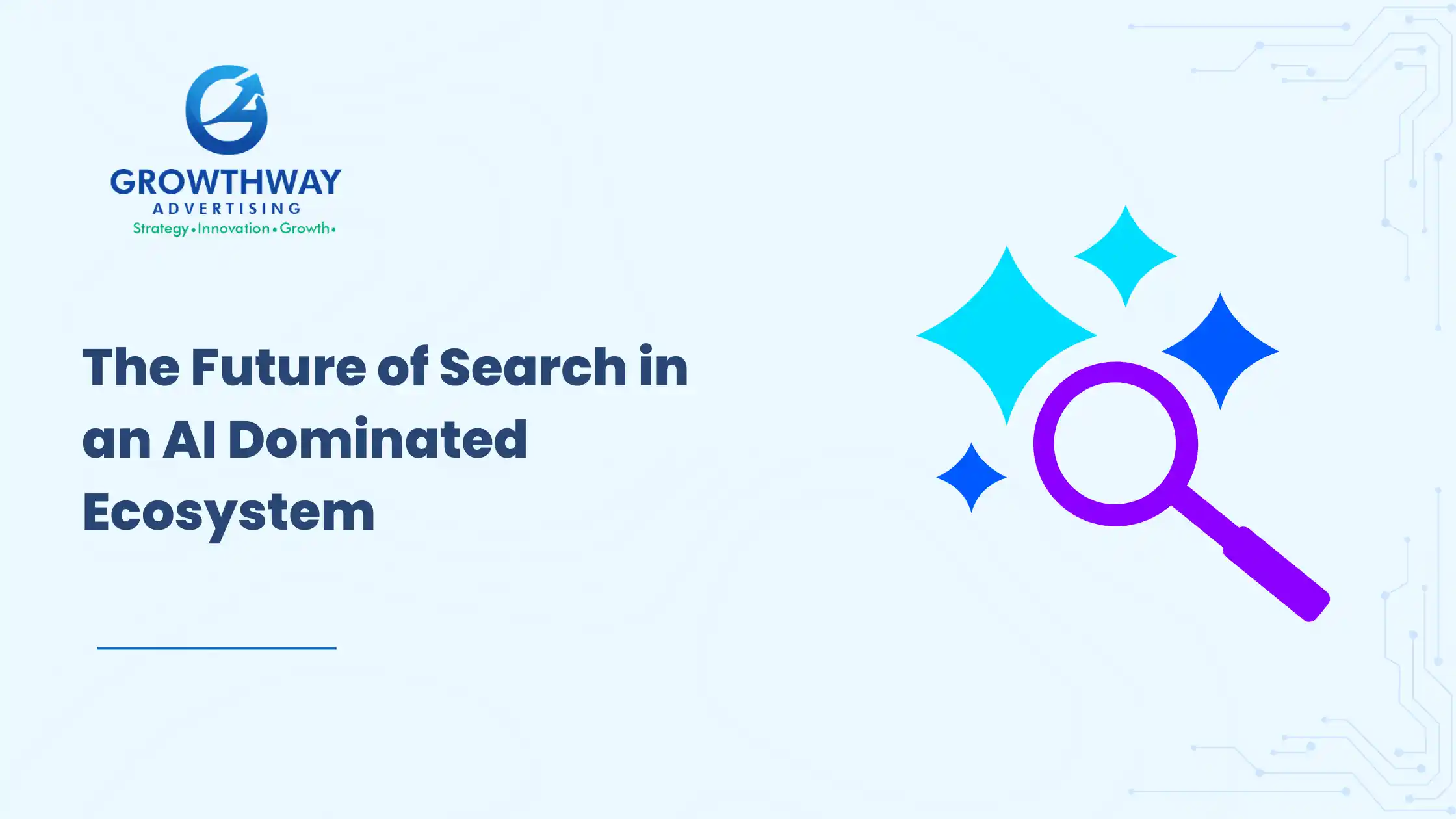
Today, search engines do more than just list results. They generate answers, summarize information, and pull from multiple sources. Often, users get what they need without clicking any links. If your brand isn’t showing up in these generated answers, you’re missing out on a key part of modern search.
This is where AI visibility in search becomes critical.
This shift doesn’t mean giving up on SEO. Instead, it’s about adapting your approach. Rankings are still important, but real growth now depends on whether AI systems use and trust your content.
Let’s look at how search has shifted from rankings to AI visibility, what most businesses focus on, what they often overlook, and how you can build a strategy for lasting search engine growth.
Why Rankings Alone Don’t Drive Growth Anymore
Traditional SEO focused on optimizing for algorithms that ranked web pages. The strategy revolved around keyword placement, backlinks, technical performance, and domain authority.
Those basics are still important. But now, search engines use AI to understand what users want and generate answers right in the results. Features like AI summaries and conversational responses have changed how people search. This is where optimizing for AI overviews becomes important.
Instead of asking, “How do we rank number one?” businesses now need to ask, “How do we get cited in AI-generated answers?”
This shift means you need a whole new approach.
What Is AI Visibility in Search?
AI visibility in search means how often your brand shows up in AI-generated answers, not just in regular search listings.
This includes being:
- Referenced in AI-generated summaries
- Cited as a source in answer boxes
- Included in conversational search responses
- Associated with authoritative explanations on specific topics
AI systems do more than show links. They read, pull out, and combine information. If your content isn’t clear and well-structured, it won’t appear in these answers.
So, being visible now depends on how clear, relevant, authoritative, and well-structured your content is.
From SEO to Generative Engine Optimization
With AI-driven search, a new approach called generative engine optimization has emerged. Traditional SEO is about ranking, but generative optimization is about becoming a trusted source that AI uses to create answers.
This difference may seem small, but it has a big impact.
Traditional SEO asks:
How do we rank for this keyword?
Generative optimization asks:
How do we become the best structured, most authoritative answer to this query?
AI models prefer content that is:
- Clearly organized
- Direct in answering questions
- Supported by contextual depth
- Semantically rich rather than keyword-heavy
This is why informational intent queries are increasingly important.
Searches like “how to optimize for AI search engines,” “AI search ranking factors,” or “how to get cited in AI search results” signal learning intent. AI systems heavily rely on these explanatory pieces when generating responses.
How AI Search Interprets Your Content
To stand out, you need to know how AI reads and uses information.
AI systems prioritize clarity over cleverness. They favor content that:
- Uses question-based headings
- Provides concise answers early
- Expands with structured explanations
- Demonstrates topical authority
For example, if someone searches “AI search vs traditional SEO,” the AI looks for content that clearly explains both and compares them directly. Long introductions without clear answers make it harder for AI to use your content.
This is why using clear structure matters. Putting a direct answer right under a question heading makes it more likely your content will be included in AI-generated summaries.
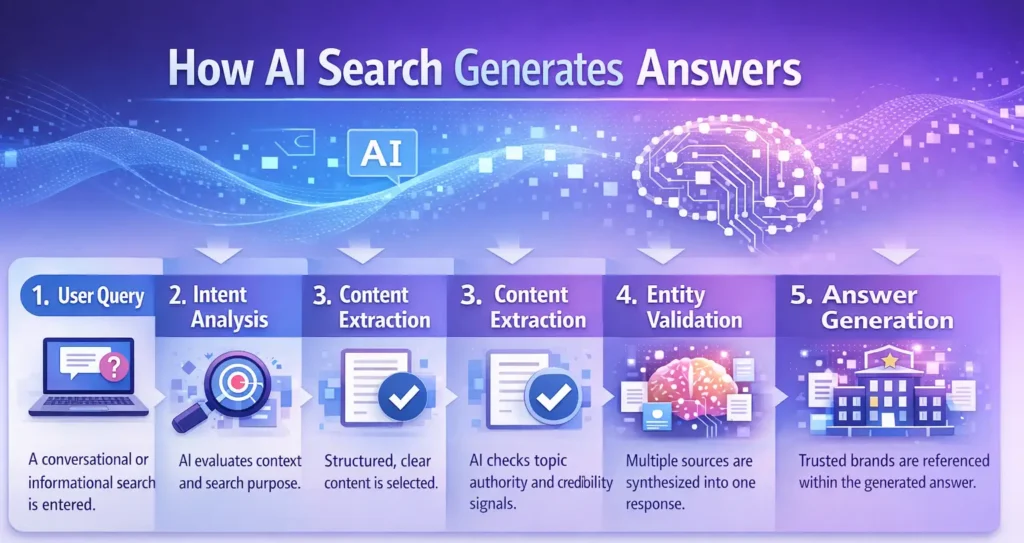
AI Overviews Optimization and Structured Clarity
With AI overview optimization, your content must serve two audiences simultaneously: humans and machines.
AI overviews pull together information from different sources into one answer. To be included, your content should clearly address what the user wants and be easy for AI to extract.
Effective structure looks like this:
- A clear, intent-focused heading
- A concise explanation immediately below it
- Supporting depth and context after the direct answer
This approach aligns with informational queries such as “what is AI visibility in search,” “structured data for generative search,” and “AI-friendly content format.” It increases the likelihood that your content will be included in the synthesized response.
Clarity isn’t just nice to have anymore, it’s a key part of your strategy.
Measurement: Tracking AI Visibility
A major gap in many strategies is how results are measured. Many businesses still depend on old ranking tools, but these don’t show how often your brand appears in AI-generated answers.
To measure AI visibility effectively, you need to monitor:
- Citation frequency within AI-generated answers
- Brand mentions in conversational search outputs
- Share of voice across AI-driven queries
- Zero-click exposure trends
This is why modern SEO services are changing. Instead of just tracking keyword rankings, advanced reports now include AI citation tracking and monitoring of your brand as an entity.
If you don’t measure the right things, your optimization efforts are just guesses.
Entity Building: The Strategic Layer Most Businesses Miss
Many strategies miss out by not focusing on building entities.
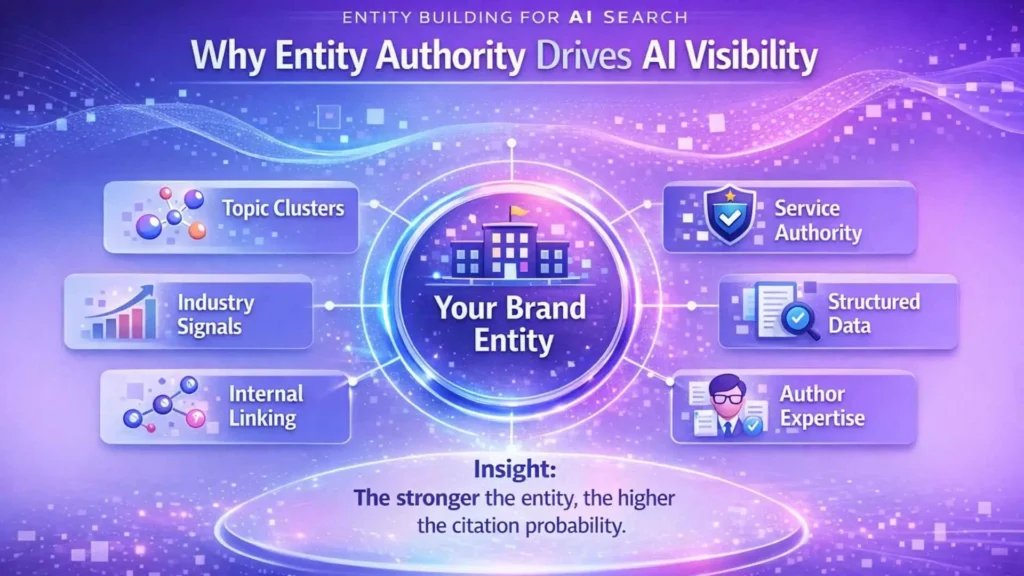
Search engines increasingly rely on entity recognition to validate expertise. An entity represents a clearly defined concept associated with your brand, services, and knowledge areas.
If your brand regularly publishes content about AI visibility, structured data, and search growth, AI systems start to connect your brand with those topics.
This increases your chances of being mentioned in AI-generated answers.
Building entity authority requires:
- Consistent topic clusters
- Structured internal linking
- Clear service positioning
- Schema markup that reinforces context
A smart SEO agency knows that building entity strength takes time and pays off. Posting random blogs won’t have the same effect.
Multimodal Optimization: The Overlooked Edge
Most conversations about AI visibility focus just on written content. But AI models are now also processing visual and structured data.
Multimodal AI search optimization involves enhancing:
- Image alt text
- Contextual captions
- Infographic explanations
- Video transcripts
- Data tables with clear headings
AI systems pull insights from more than just text. Brands that also optimize images, videos, and data tables get an advantage many competitors miss.
Zero-Click Search and Conversion Strategy
AI-generated answers mean more users get what they need without clicking. Growth doesn’t disappear, it just requires a new strategy.
Instead of just chasing clicks, you should focus on building your brand’s authority.
When your brand keeps showing up in AI answers, people start to trust you more. They search for you directly, and conversion rates go up as they become more familiar with your brand.
That’s why questions like “future of AI in search engines” and “is SEO dead because of AI” are important. They catch people’s attention early, giving your brand a chance to shape opinions before competitors do.
Industry-Specific AI Visibility Strategies
AI visibility tactics differ across industries.
Ecommerce brands must prioritize structured product data and clarity in specifications. SaaS companies benefit from technical explainer content that answers layered questions. Local businesses strengthen visibility through location-based entity reinforcement.
Generic advice doesn’t work as well. AI strategies tailored to your industry send stronger signals, and AI systems reward that relevance.
Integrating Traditional SEO With AI Strategy
The future of search isn’t about choosing between SEO and AI. It’s about using SEO together with AI insights.
Technical health still matters. Crawlability, page speed, clean architecture, and internal linking remain foundational. AI systems rely on structured, accessible content.
But when you add generative engine optimization to those basics, you can greatly improve your visibility.
When your content is clear, technically strong, and seen as an authority, your brand can both rank well and be used as a source in AI answers.
The Real Shift: Influencing Answers, Not Just Rankings
Growing your presence in search today means shaping the conversation itself.
It means optimizing for:
- Informational intent depth
- Extractable clarity
- Entity recognition
- Conversational search behavior
- AI citation patterns
Businesses that focus on AI visibility stop just chasing rankings. They become trusted sources in the AI world.
In a world where search engines create answers instead of just listing links, being the source for those answers is much more valuable than being just another link.
FAQ’s
AI visibility in search refers to how often your brand appears inside AI-generated answers, summaries, and overviews rather than just traditional search listings.
Generative engine optimization focuses on structuring content so AI systems can extract and cite it in generated answers, while traditional SEO focuses mainly on rankings.
By creating clear, question-based content, strengthening entity authority, implementing structured data, and consistently covering informational search intent topics.
Yes. Technical SEO, structured architecture, and authority building remain foundational. Modern seo services now combine traditional optimization with AI visibility strategies.
You can track AI citations, brand mentions in generated answers, share of voice across AI responses, and zero-click exposure trends.
Not necessarily. If your brand appears in AI-generated answers, it builds authority and trust, which can increase direct searches and conversions over time.