If you’re serious about Email Marketing, you already know the inbox is more competitive than ever. Open rates in 2025 sit at an average of 21 to 24 percent, and click-through rates hover around 2 to 3 percent. Here’s the thing: most of the emails that get ignored don’t fail because the product is bad. They fail because the message feels generic, poorly timed, or simply not meant for the person receiving it.
So let’s break it down. If your emails aren’t connecting, it’s usually because the personalization is superficial or the copy feels like it could have been sent to anyone. The good news is that engagement isn’t random. You can learn how to shape messages people actually want to open. This guide walks you through the strategies, frameworks, and psychology that top brands use and how you can use them too.
The Changing Email Landscape in 2025
Email is nowadays quite a different event compared to the email just two years ago. AI sits at the center of modern email marketing strategy, influencing everything from content suggestions to send-time prediction.
Now AI-based solutions examine millions of data points to enhance email engagement tip recommendations in real time. This encompasses tone recommendations, user behaviour predictions, and assisting teams to write wiser text at a quicker pace. The AI email personalization will also change drastically. It is taken much further than putting the first name of someone in the greetings. Personalization is now generated based on contextual information, the last thing the user clicked on last week, the web pages they read, the frequency of the emails that they respond to, or even the duration of time that the user has not interacted.
AI has also redefined A/B testing. Instead of testing two versions of a subject line, AI tools can generate and test dozens automatically, learning which frameworks perform best for each segment. This hypercharges the manner in which marketers undertake compelling subject lines; in particular, when dealing with privacy updates such as Apple Mail Protection and GDPR. The importance of clean data is not new but more effective than ever due to increased dependability on first-party data in order to create smarter personalization.
Subject Lines That Demand Attention
The most outstanding email would be ignored in case the subject line fails to impress. In 2025, concise subject lines continue to perform well compared to the long ones, particularly subject lines that have conversational tone. Think of them as micro-hooks, your first job is to create enough curiosity for the open.
You’ll see strong trends toward emotional triggers, subtle mystery, and straight-to-value statements. People respond to clarity and intention. For example:
- Curiosity gap: You missed something important.
- Value-first: A faster way to fix your workflow.
- Emotional pull: Why your productivity feels stuck lately.
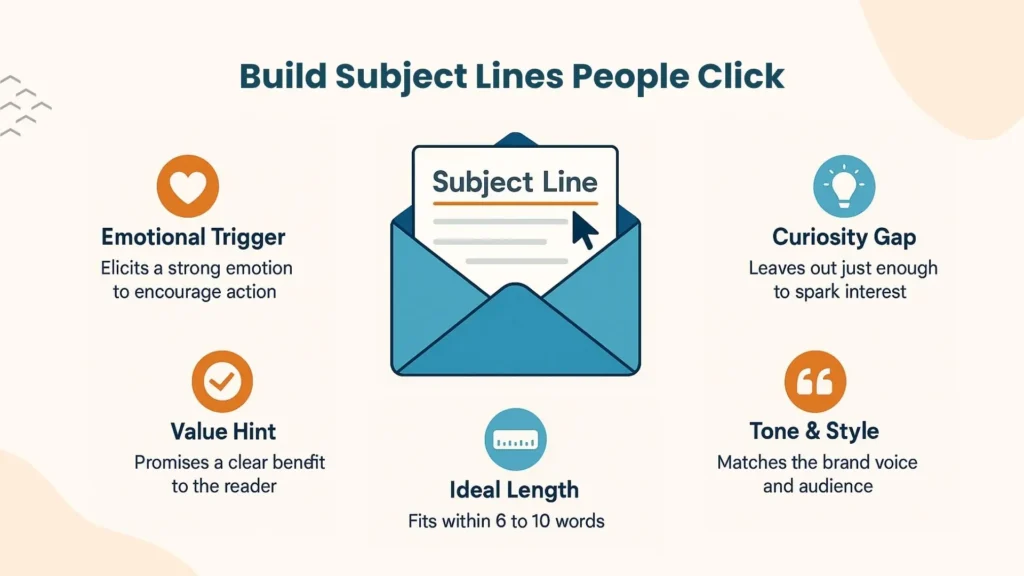
Using emotional language doesn’t mean being dramatic. It means aligning with the user’s current priority, saving time, solving a problem, or improving their skills. AIs are now actively proposing new structures of compelling subject lines, based on predictive scores of performance. Subject line data can be used in reference to industry trends and audience behavior, rather than making guesses.
Personalization Beyond First Names
When the personalizing process starts and ends with Dear Rohit, you have already lost the attention of the subscriber. The most effective emails incorporate AI email personalization which follows behavior and context. Here’s what that looks like.
Micro-segmentation created based on behavior and not demographics. Perhaps, someone has gone through your pricing page twice and has not registered. Perhaps they constantly have productivity content but do not pay attention to sales messages. Or perhaps they just talk at night on the mobile. These aren’t random details, they’re signals you can build smarter journeys around.
Brands like Notion and Grammarly use dynamic modules that shift based on the reader’s real-time usage patterns. This is the next level of personalizing your emails. Instead of manually building 10 separate versions of a newsletter, you create one modular framework that rearranges itself depending on who is opening it.
It has become possible to create personalized content blocks, suggest send times, analyze intent, and AI can do it without requiring any additional human effort.
Copywriting Secrets for Higher Engagement
Once your subscriber opens the email, the real work begins. Strong Email copywriting doesn’t feel like copy. It feels like a helpful conversation.
Let’s talk tone first. The best-performing emails use a relaxed, conversational style that focuses on solving a problem quickly. People skim, so scannability matters. Short paragraphs. Clear subheads. Crisp value.
Frameworks like PAS (Problem, Agitate, Solution) and AIDA help you get to the point. For example:
- Call out the problem clearly.
- Make the pain or urgency feel real.
- Present a solution that feels simple and doable.
Hooks that are narrative are also extremely effective. They bring the reader to a point where he/she could visualize themselves and their predicament.
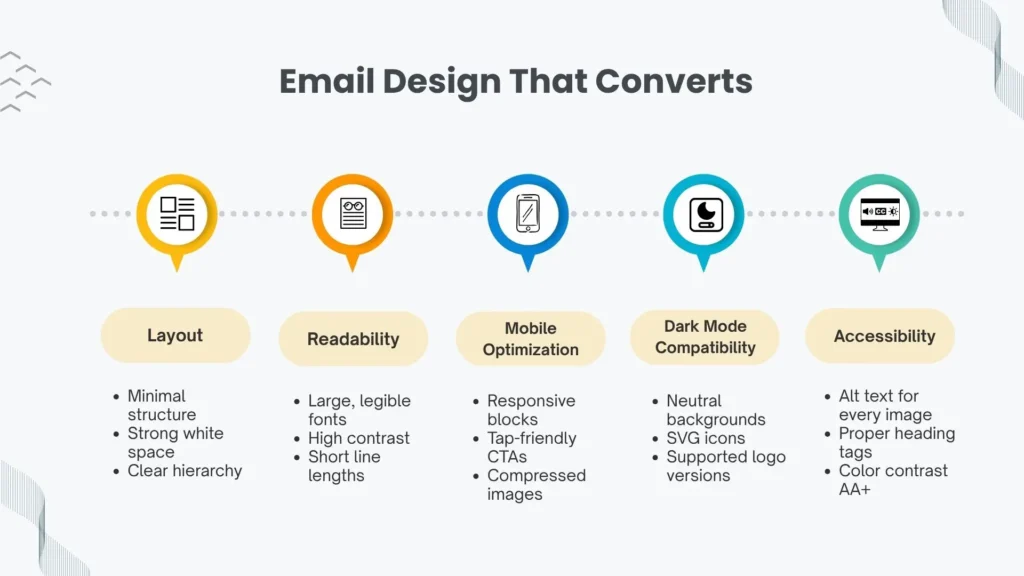
Modern email design practices include mobile optimization. The majority of users will first scan emails on the phone. That consists of keeping lines short, quick bullets and your primary CTA should be visible at the top first. You are not simply writing, you are creating a reading experience.
Email Design and UX Principles
Simple designs beat complex designs in 2025. The movement is more towards minimalist buildings with extreme contrast and purposeful distance. There are icons, light drawings, and minor visual indicators that facilitate the direction of the attention without congesting the reader.
Accessibility also matters. It is now necessary to be compatible in dark mode. When your design fails in dark mode, then you have lost your credibility immediately. Best practices include modern email design; it should be made up of alt text, a proper contrast, and readable font sizes.
Timing matters too. According to the trend of data on 2025, mornings during a week are still good, but the generalized timing principles are substituted with AI tools. Marketers are no longer attentive to the advice of the generic industries but are resorting to email testing and predictive send-time optimization in order to have AI send emails when each individual subscriber is most likely to open.
Analytics and Continuous Optimization
Open rates don’t tell the full story anymore. High-performing brands look at metrics like:
- Scroll depth
- Engagement time
- CTA interaction patterns
- Content preferences by cohort
AI can now analyze these patterns and predict subscriber churn, helping you refine your email marketing strategy before engagement drops.
Such tools as the AI optimizer of Mailchimp, the adaptive testing functionality of HubSpot, and the predictive language engine of Phrasee have become daily necessities of the teams that want to maintain an advantage. Using them, they make you develop smarter and more responsive campaigns that develop without guessing.
If your team works with an email marketing agency, make sure they’re using these tools and not relying on outdated rules. In India, most email marketing agencies are using AI-based testing and segmentation to compete. The real strength that you have is adaptive analytics whether you are outsourcing email marketing firms or developing internal capabilities.
Takeaway Framework
Let’s wrap it up with a simple framework you can use for every campaign: Hook – Value – CTA.
The hook buys the first five seconds. Your value section delivers what the user actually cares about. The CTA closes the loop by showing them what to do next.
The trick is iterative refinement. Keep running email testing, keep personalizing intelligently, and keep refining based on behavior, not assumptions.
If you apply these email engagement tips, use smarter segmentation, rely on AI email personalization, and partner with the right email marketing services or an email marketing agency, your emails won’t just get opened, they’ll get remembered.
FAQ’s
A mix of a strong subject line, clear value in the opening sentence, and personalization tied to behavior not just names dramatically boosts engagement.
Use behavioral signals like browsing patterns, past clicks, and timing preferences. This makes the email feel relevant instead of forced.
Yes. AI can optimize subject lines, predict send times, segment users, and guide copy adjustments that increase opens and clicks.
Overcrowded layouts, tiny fonts, broken dark-mode rendering, poor contrast, and image-heavy templates that don’t load quickly.
Use a conversational tone, short paragraphs, strong hooks, and scannable sections. Deliver value fast and place the CTA where it’s easy to spot.
Absolutely. AI-driven send-time optimization shows that personalized timing improves open and click rates far more than generic “best days.”