Search engine optimization has evolved into a system driven by data, speed, and consistency. What once involved occasional keyword research and manual page optimization now requires constant monitoring, analysis, and updates. Websites compete in dynamic search environments where rankings shift frequently and new competitors enter the results every day. For businesses investing in seo services, managing these moving parts manually can quickly become inefficient.
This is where SEO Automation becomes valuable. Automation allows SEO teams to handle repetitive processes automatically while focusing their attention on strategic decisions that improve visibility and traffic. When automation tools are connected through a clear SEO Workflow, the entire optimization process becomes more organized, scalable, and effective.
Automation does not replace SEO expertise. Instead, it supports it by removing time-consuming tasks like data collection, rank tracking, and technical monitoring. The result is a workflow that runs continuously in the background while specialists focus on improving strategy, content quality, and user experience.
Why SEO Automation Is Becoming a Core Part of SEO
Search engines analyze hundreds of ranking signals including content relevance, technical performance, backlinks, and user engagement. At the same time, websites are publishing more content than ever before. This creates an environment where manual optimization alone cannot keep up.
Automation helps solve this challenge by running ongoing analysis without requiring constant manual input. Instead of checking rankings or site errors one by one, automation tools scan entire websites and search results automatically.
For a growing seo agency, this efficiency is especially important. Agencies often manage multiple client websites, each with hundreds or even thousands of pages. Automation ensures every project receives consistent monitoring and optimization.
The biggest benefits of automation include:
- Continuous website monitoring
- Faster data analysis and reporting
- Improved accuracy when tracking rankings and performance
- Reduced time spent on repetitive tasks
With these systems in place, SEO professionals can focus more on improving search visibility and less on collecting raw data.
Building an Effective SEO Workflow
Automation becomes powerful when it is organized within a structured SEO Workflow. A workflow connects different SEO activities so that insights from one stage inform actions in the next stage.
Instead of isolated tasks, the process becomes a cycle of research, implementation, analysis, and improvement.
A typical workflow used by professional seo services often includes the following stages:
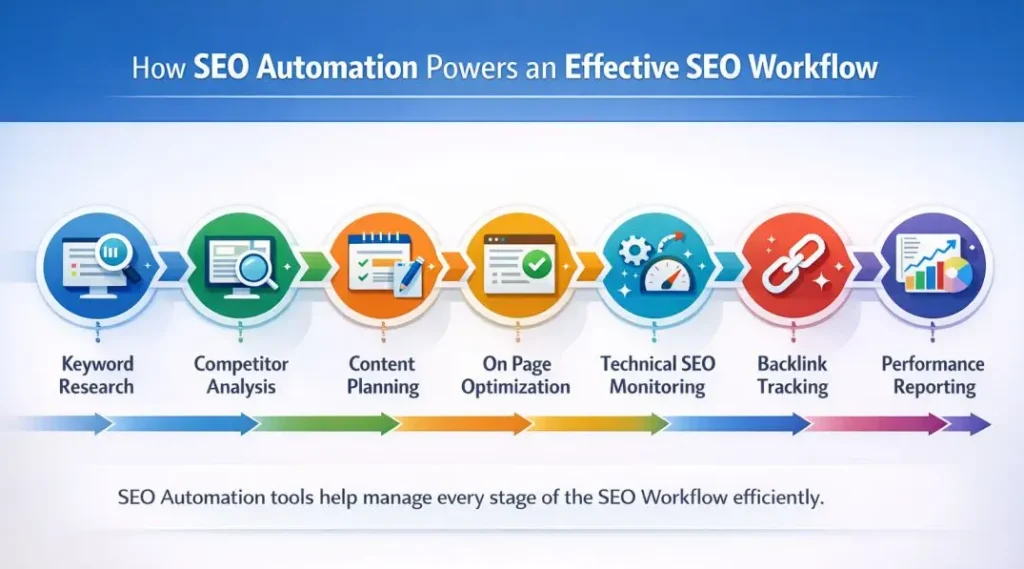
- Keyword and search intent research
- Competitor analysis
- Content planning and optimization
- Technical SEO monitoring
- Link tracking and authority building
- Performance reporting and improvement
Each stage feeds data into the next, creating a continuous improvement loop that strengthens search performance over time.
Keyword Research and Topic Discovery
The first stage of any SEO process is understanding how people search for information online. Automation tools analyze massive datasets of search queries to identify opportunities that may otherwise go unnoticed.
Instead of simply looking at high-volume keywords, modern research tools also evaluate search intent and topic relationships. This helps SEO teams build content that answers real user questions rather than targeting isolated keywords.
Automation tools typically help identify:
- Long tail keywords with lower competition
- Related search queries and topic clusters
- Seasonal search trends
- Keyword difficulty and ranking potential
These insights allow SEO professionals to develop stronger content optimization strategies that align with user intent.
When keywords are organized into topic clusters, websites can build topical authority around specific subjects. Search engines often reward this type of structure because it signals deeper expertise.
Competitor Insights and Market Analysis
Understanding competitor strategies is another area where automation delivers significant value. Instead of manually reviewing competitor websites, automation platforms continuously monitor competitor performance.
These tools reveal valuable insights such as:
- Keywords competitors are ranking for
- New content they publish
- Backlinks they acquire
- Changes in their search visibility
This type of competitor analysis helps SEO teams discover new opportunities quickly. If a competitor gains traffic from a new topic, the insight appears immediately, allowing your strategy to respond faster.
For agencies delivering seo services, competitor monitoring ensures that client campaigns remain competitive in evolving search landscapes.
Content Optimization and Production
Content remains one of the most important factors in SEO success. However, producing optimized content requires research, structure, and continuous updates.
Automation tools now assist content teams by analyzing the structure of high-ranking pages and identifying patterns in search results. These tools evaluate factors such as topic coverage, semantic keyword usage, and content depth.
During content development, automation platforms often provide recommendations related to:
- Keyword placement and semantic relevance
- Heading structure and readability
- Topic coverage and missing subtopics
- Internal linking opportunities
This type of support strengthens on page SEO without replacing human creativity. Writers still craft the narrative, explain concepts clearly, and ensure the content connects with readers.
Automation simply ensures that important optimization elements are not overlooked.
Technical SEO Monitoring
Technical health plays a major role in how search engines crawl and index websites. Problems like broken links, slow loading pages, or incorrect redirects can reduce visibility even if the content itself is strong.
Automation tools continuously scan websites and detect technical issues before they cause serious ranking problems.
Common issues identified through automated technical SEO audits include:
- Broken internal or external links
- Duplicate content pages
- Missing or incorrect meta tags
- Page speed performance problems
- Crawl errors and indexing issues
Instead of discovering these problems months later, automation alerts teams as soon as something changes. This proactive approach keeps websites technically optimized and easier for search engines to understand.
Internal Linking and Site Structure
Internal linking helps search engines understand how pages relate to one another. It also distributes authority across a website and improves navigation for users.
Many websites miss internal linking opportunities simply because tracking relationships between hundreds of pages is difficult manually. Automation tools analyze page topics and recommend relevant internal links.
Automated suggestions often focus on:
- Linking related articles within topic clusters
- Strengthening important pages with additional links
- Connecting new content to existing high authority pages
When implemented consistently, internal linking strengthens overall site architecture and improves search engine crawling efficiency.
Backlink Monitoring and Authority Growth
Backlinks remain an important ranking factor because they signal trust and authority. Monitoring backlinks manually can be challenging, especially for large websites with thousands of referring domains.
Automation tools simplify this process by tracking link activity continuously. They identify new backlinks, detect lost links, and monitor the quality of referring domains.
SEO teams often track backlink data such as:
- New referring domains
- Lost backlinks that require recovery
- Anchor text distribution
- Domain authority changes
These insights support effective link building strategies while protecting websites from harmful or spam links.
For agencies managing multiple campaigns, automated backlink monitoring ensures that link profiles remain healthy and competitive.
Performance Tracking and SEO Reporting
After research, optimization, and implementation, the final stage of a strong SEO Workflow focuses on measuring results. Automation platforms track performance metrics and generate reports that summarize campaign progress.
Instead of manually compiling data from different platforms, automated systems combine analytics, keyword rankings, and technical insights into a single dashboard.
Important metrics typically tracked include:
- Organic search traffic growth
- Keyword ranking improvements
- Click through rates in search results
- Page engagement and user behavior
- Conversions generated from organic traffic
For businesses working with a seo agency, automated reporting improves transparency and helps connect SEO efforts directly to business outcomes.
Scaling SEO With Automation
One of the most important benefits of SEO Automation is scalability. As websites grow, the number of pages, keywords, and performance indicators increases dramatically. Without automation, managing these elements becomes difficult.
Automation systems allow SEO teams to maintain consistent optimization across large websites. Instead of manually reviewing each page, automated tools highlight areas that need attention.
A scalable SEO Workflow often includes routine processes such as:
- Daily monitoring of rankings and technical alerts
- Weekly content optimization reviews
- Monthly technical audits and performance analysis
This structure ensures that important SEO activities continue consistently while allowing teams to focus on high-impact improvements.
As search competition continues to increase, automation is becoming a foundational component of professional seo services. When integrated properly into a structured workflow, it transforms SEO from a collection of manual tasks into a system that continuously improves search visibility, website authority, and organic growth.
FAQ’s
1. What are SEO Automation tools?
SEO Automation tools are software platforms that automate repetitive SEO tasks such as keyword tracking, technical audits, reporting, backlink monitoring, and site analysis.
2. How does SEO Automation improve an SEO Workflow?
SEO Automation improves an SEO Workflow by collecting data automatically, identifying issues quickly, and allowing SEO teams to focus on strategy instead of manual tasks.
3. What tasks should be automated in SEO?
Common tasks automated in SEO include rank tracking, technical audits, backlink monitoring, competitor analysis, keyword research insights, and performance reporting.
4. Are SEO Automation tools useful for small businesses?
Yes. Even small businesses using seo services benefit from automation because it helps track rankings, detect technical issues, and monitor website growth.
5. How often should SEO automation reports be reviewed?
Most SEO teams review automated reports weekly or monthly to evaluate ranking improvements, traffic growth, and technical health.
6. Does SEO Automation help with technical SEO?
Yes. Automation tools regularly scan websites to detect crawl errors, broken links, page speed issues, and other problems found in technical SEO audits.