A DIY website often feels like the smartest option at the start. It’s affordable, fast to launch, and promises control without technical complexity. For many businesses, that’s enough to get online.
The issue lies with post-launch.
A DIY site can hardly go wrong. It usually looks fine. It functions. Pages load. Forms work. However, under the carpet, it decreases trust, visibility and conversions. Over time, that gap turns into lost clients. It is at this point that most business owners start posing the same question, why is my site not generating any leads yet it is live?
The answer almost always lives in the limitations of a DIY build.
First Impressions Decide Everything
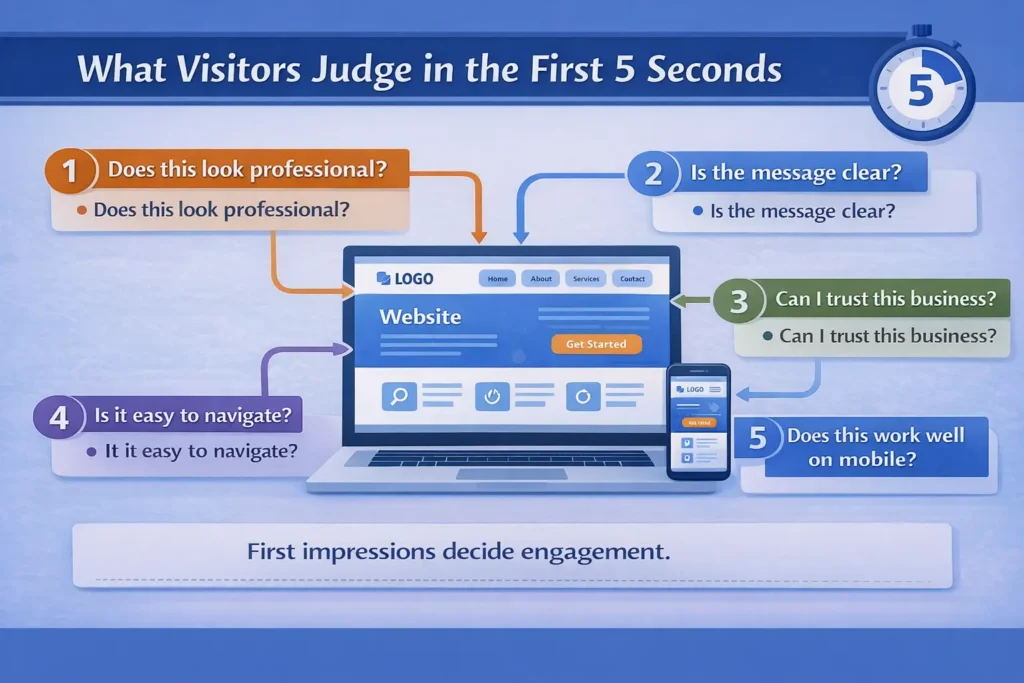
Your website is often the first real interaction someone has with your brand. Before they read reviews, book a call, or compare pricing, they make a judgment in seconds.
DIY websites are very dependent on ready-made layouts. Those layouts are very convenient but they are familiar in the wrong way. Even though visitors may not be able to explain why a site appears generic, they will still be aware of it.
Examples of Killers of trust are:
- Layouts that are template based and have no hierarchy.
- Stock images which do not represent the business.
- Irregular spacing, fonts, and colors.
- Blended messaging, rather than stand-out messaging.
When there is a lack of trust the people hesitate. Where indecision sets in, conversions are lost.
A professionally built website focuses on clarity, credibility as well as purpose. An efficient website development company creates according to the way the users think, scroll, and choose. Such distinction is all that can make or break your call or click and get a response.
Visibility Problems Start at the Structure Level
DIY websites tend to promote integrated SEO. Usually available are titles, meta descriptions and simple optimization. But ranking isn’t about tools. It’s about structure.
Most DIY sites have problems with:
- Stuffed code that slows down loading
- Limited control over technical SEO
- Poor internal connection frameworks
- Inflexible URL formatting
- Poor mobile performance
This brings about a general frustrating fact; I have a site, and people just cannot find it.
Speed, clarity and crawlable architecture are rewarded by search engines. Those requirements are considered during the very first steps of the development of professional websites. Clean code, fast performance, logical page relationships, and scalable optimization give search engines what they’re looking for.
That is the way visibility grows with the years rather than levels off.
Conversion Is Where DIY Sites Lose the Most Value
Traffic doesn’t equal growth. Conversion does.
The DIY websites are usually constructed page after page rather than journey after journey. This implies that visitors arrive, scroll, and take off without a sense of what they are expected to do next.
Typical issues include:
- Weak or unclear calls to action.
- Excessive information on the above fold.
- No visual guide to the user.
- Forms placed without intent
- Mobile layouts that bury key actions
This is what makes visits to be frequent with no questions posed by many businesses.
Professional web development services focus on behavior, not decoration. There is no section which has no purpose. All call of actions are placed at the point where the users are willing to take action. The layouts are made in ways that minimize friction as well as maximize confidence.
The Time Cost Most Business Owners Underestimate
DIY websites don’t just cost money. They cost focus.
A DIY site may require you to manage:
- Adjusting layouts manually
- Fixing mobile responsiveness issues
- Troubleshooting plugins or integrations
- Updating content and images
- Handling backups and basic security
Everything is small and all these will count. That time comes directly out of sales, strategy, or client work. This is the actual opportunity cost of a DIY site. When you work with a professional web development agency, the website stops demanding attention. It becomes a stable platform that supports growth without constant intervention.
Growth Exposes DIY Limitations Quickly
DIY websites are good when it comes to dealing with simple requirements. Growth is where cracks appear.
As businesses expand, they often need:
- CRM integrations
- Advanced forms and automation
- Custom landing pages
- Performance optimization
- Better analytics and tracking
DIY platforms tend to resist customization. It becomes costly, time-consuming or impossible to add features. Migration later can be disruptive and risky. Professional website development services are built with scalability in mind. The architecture supports future needs without forcing a rebuild every time the business evolves.
Security and Maintenance Are Silent Risks
DIY sites make it easier to set up however, transferring the burden to the business owner.
Security concerns usually arise out of:
- Missed updates
- Weak hosting environments
- Plugin conflicts
- Limited server-side protection
Most companies are not aware of the existence of the problem until they experience downtime, data loss, or a decline in performance.
Security is dealt with proactively by professional website development services. The foundation does not comprise updates, monitoring, backups, and performance checks as an afterthought.
The Revenue Impact Most People Miss
A DIY website doesn’t usually block growth outright. It slows it.
Here’s how revenue leakage happens:
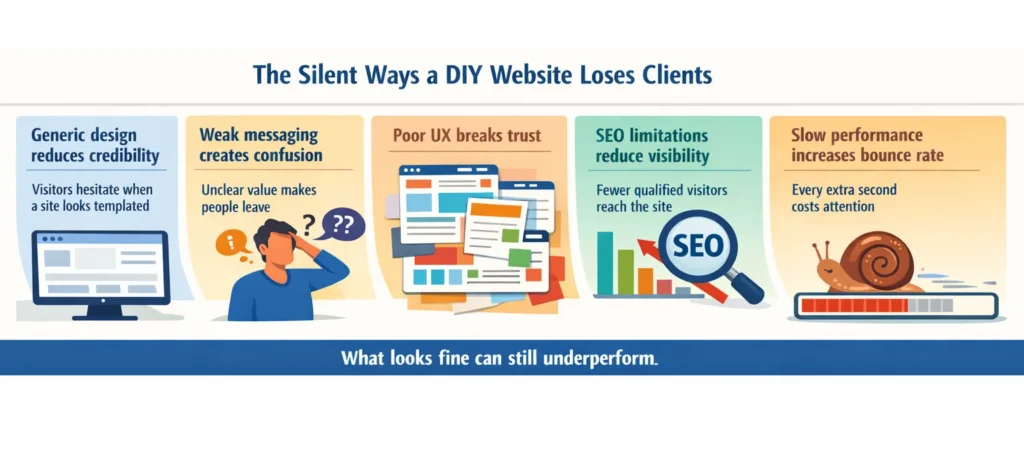
- Slower sites reduce engagement
- Poor UX increases bounce rates
- Weak SEO limits qualified traffic
- Generic design lowers perceived value
One factor makes another more complex. Technically, the site is working, but not performing well. It is not the presence online, but speed, the quality of leads, the conversion rate, and ROI in the long run.
How a Professional Build Changes the Outcome
A well developed Web site changes the way your business competes.
You gain:
- Good positioning and messaging.
- SEO-ready architecture
- Conversion-focused layouts
- Faster load times
- Strong mobile performance
More convenient combination with marketing tools. Rather than asking why the site is not working, you start tracking how it’s supporting growth. That is the difference between an existence and a performance web site.
When a DIY Website Makes Sense
DIY websites may be handy in:
- Early-stage ideas
- Temporary projects
- Simple informational pages
However, restrictions become apparent within a short period of time when a site is supposed to produce leads, promote its brand and support it.
The Real Question Business Owners Are Asking
It is not whether it is possible to create a DIY site. It’s whether the business can afford the clients it never sees, the trust it never earns, and the opportunities it never converts.
That cost doesn’t show up on an invoice. It shows up in missed growth.