Search behavior has changed quietly but decisively. Users still type queries into Google, but the journey that follows looks very different. With google ai overview, answers often appear instantly at the top of the results page, reshaping how people interact with links, brands, and information.
Click-through rates are no longer driven by ranking alone. They’re shaped by intent, trust, and how effectively content aligns with AI-driven search behavior. Understanding this shift is essential for anyone relying on organic search as a growth channel.
What Google’s AI Overview actually changes in search behavior
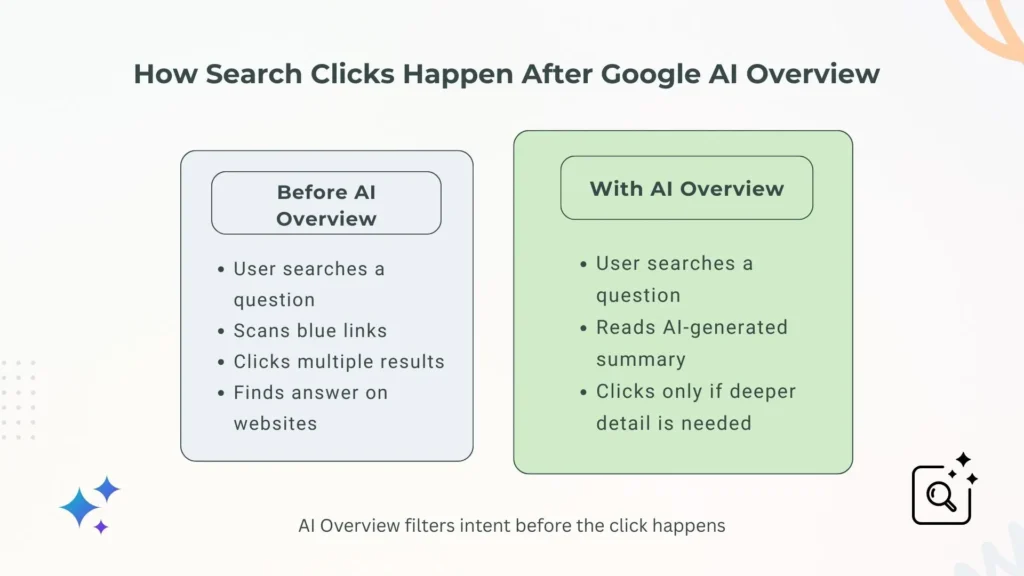
Google’s AI Overview pulls together answers directly on the search results page. Instead of scanning links, users read a synthesized response built from multiple sources. That alone changes the role of organic search.
Previously, rankings mattered most. Now, visibility inside the AI-generated answer matters just as much, sometimes more. This evolution builds on what Google earlier tested as Search Generative Experience, but the current rollout is far more aggressive and widely visible.
The key behavioral shift is simple:
Users click less for basic understanding and click more when they need depth, comparison, or action.
This is why CTR isn’t just dropping uniformly. It’s being redistributed.
Why click-through rates are falling unevenly, not universally
A mistake many marketers make is assuming AI Overviews kill clicks across the board. That’s not what the data or user behavior suggests.
CTR changes depend heavily on:
- The type of search query
- How complex the answer is
- Whether trust or expertise is required
- How close the user is to a decision
This is where Traditional SEO thinking starts to fall short. Ranking number one no longer guarantees traffic if the AI Overview already satisfies intent.
Industry-by-industry CTR shifts explained clearly
Publishing, blogs, and informational sites
Industries built on surface-level explanations see the biggest CTR drops.
“How does,” “what is,” and “why” queries are now frequently answered directly. If your content repeats definitions without adding depth, clicks decline sharply.
However, sites that provide:
- Original examples
- Step-by-step frameworks
- Updated data
- Clear authorship and credibility
still attract clicks, especially when Google signals trust through E-E-A-T principles.
SaaS and B2B services
B2B hasn’t been hit as hard as people think.
AI Overviews summarize problems well, but they struggle with:
- Vendor comparisons
- Use-case-specific workflows
- Pricing nuance
- Implementation details
That’s why SaaS brands investing in content strategy that goes beyond definitions often see stable or even improved CTR. AI answers introduce the problem, but users still click to evaluate solutions.
This is where smart seo services and thoughtful seo marketing make a difference.
Local and service-based businesses
Service industries show a mixed pattern.
Generic service explanations lose clicks, but localized and intent-driven searches still perform well. AI can explain “what a service is,” but it can’t replace:
- Local trust
- Reviews
- Experience
- Human reassurance
For agencies, consultants, and professionals, AI Overview visibility often increases brand exposure even when raw CTR dips. That visibility still matters.
A strong seo agency or experienced seo consultant now tracks visibility, not just clicks.
Ecommerce and transactional industries
Product-based searches are more resilient.
AI Overviews summarize options, but users still want:
- Images
- Reviews
- Specs
- Comparisons
- Checkout confidence
Clicks shift toward brands that appear credible and authoritative. This is where Schema markup becomes critical. Structured product data helps Google trust and reference your content accurately.
The hidden metric replacing CTR: AI visibility
CTR alone no longer tells the full story.
Brands now need to track AI visibility, which includes:
- Being cited or paraphrased in AI Overviews
- Appearing as a trusted source across related queries
- Owning concepts, not just rankings
This shift pushes SEO closer to Answer Engine Optimization, where success means being the source Google chooses to answer with, not just link to.
Many blogs talk about traffic loss but skip this completely. That’s a mistake.
Why content format now matters more than position
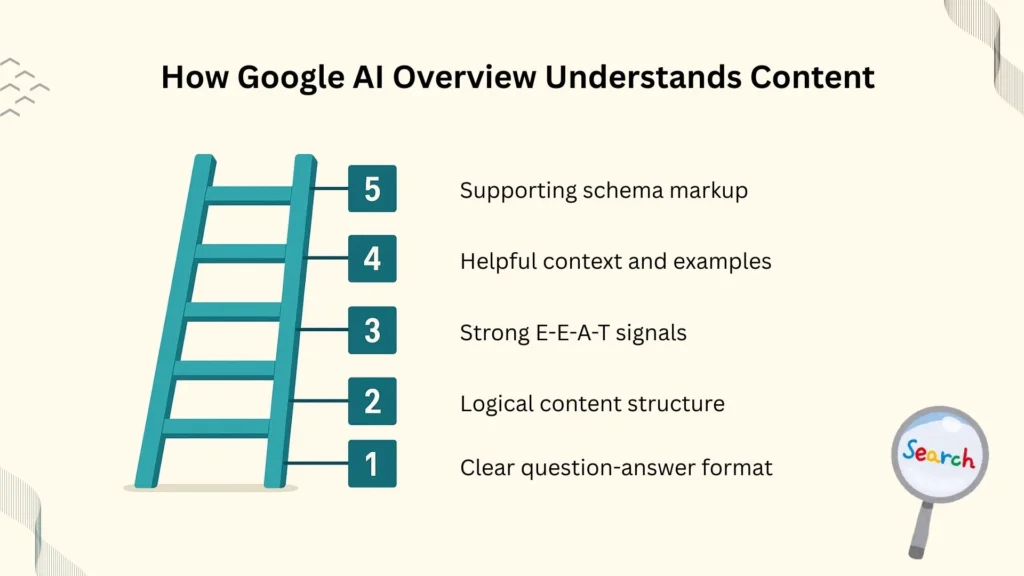
AI systems don’t read content the way humans do. They extract patterns, clarity, and structure.
Content that performs well in AI Overviews typically includes:
- Clear definitions early
- Logical subheadings
- Concise explanations
- Supporting context, not fluff
This doesn’t mean writing for machines. It means writing for clarity.
Using conversational content that mirrors how users phrase questions helps align with AI extraction and improves summarization accuracy.
How E-E-A-T directly affects CTR in the AI era
Google leans harder on trust signals when generating answers.
Strong E-E-A-T principles don’t just help rankings. They influence whether your content is considered safe and reliable enough to summarize.
This includes:
- Author expertise
- Updated information
- Real-world experience
- Transparent sources
When your brand earns trust, users are more likely to click through even after reading an AI summary.
AI Overviews don’t eliminate clicks, they delay them
This is one of the most misunderstood shifts.
AI Overviews often act as a pre-filter. Users consume a summary, then click when they need:
- Validation
- Deeper understanding
- Implementation guidance
That’s why long-form, experience-backed content still matters. It just needs to serve a different role in the journey.
A strong content marketing strategy now supports mid- and bottom-funnel intent more than top-funnel discovery.
Query intent matters more than ever
Not all queries are equal.
AI Overviews dominate:
- Definitions
- General explanations
- Broad informational searches
They struggle with:
- Personalized needs
- Industry-specific scenarios
- Decision-heavy research
Understanding this helps teams decide which content should aim for AI inclusion and which should focus on driving clicks.
This is where smart seo services outperform generic playbooks.
Voice search and AI Overviews are converging
One overlooked shift is Voice Search Alignment.
AI Overviews often mirror how voice assistants respond. Content that answers questions clearly and naturally performs better across both voice and AI-generated results.
This reinforces the importance of:
- Natural phrasing
- Direct answers
- Clear context
Optimizing for voice improves AI compatibility without extra effort.
The future role of SEO teams and agencies
SEO isn’t disappearing. It’s evolving.
Modern seo marketing teams now balance:
- Rankings
- AI visibility
- Brand authority
- User trust
A capable seo agency doesn’t just chase clicks. It builds content ecosystems that survive reduced CTR while increasing influence.
The brands that adapt fastest treat AI Overviews as a distribution channel, not a threat.
What this shift really means for growth-focused brands
CTR changes are not a loss of opportunity. They’re a signal.
Search has moved from exploration to understanding, and from curiosity to clarity. Content that respects that shift doesn’t chase clicks. It earns them when they matter most.
That’s how AI Overview reshapes behavior across industries, not by replacing value, but by redefining where value begins.
FAQ’s
1. What is Google AI Overview in search results ?
Google AI Overview is a feature that shows AI-generated answers at the top of search results by summarizing information from trusted sources.
2. How does Google AI Overview affect click-through rates ?
It often reduces clicks for basic informational queries while shifting clicks toward deeper research, comparison, and decision-focused content.
3. Which industries are most affected by AI Overview CTR changes ?
Publishing, informational blogs, and educational content see bigger CTR drops, while ecommerce, B2B, and service industries are more resilient.
4. How can businesses optimize content for Google AI Overview ?
By improving clarity, structure, expertise signals, and aligning content with real user intent rather than keyword stuffing.
5. Is ranking number one still important with AI-driven search ?
Rankings still matter, but visibility inside AI-generated answers and authority across related queries are equally important now.
6. Will AI Overview replace traditional SEO completely ?
No. Traditional SEO is evolving into a broader approach that includes answer optimization, content clarity, and trust-building.