In 2025, small businesses are no longer outmatched by big advertising budgets, they’re outsmarting them.In 2025 there is no longer an outmanship between small business and big advertising budgets, but they are outsmarting one another. With the use of smarter data, AI-based bidding, and improved targeting tools, PPC to small business has become among the strongest equalizers in digital marketing. According to recent WordStream data, businesses earn an average of ₹2 for every ₹1 spent on paid ads, but those that master PPC optimization see returns as high as ₹400 for every ₹100 invested.
Here’s the thing: while large corporations pour crores into campaigns, small businesses can win through strategy, agility, and creativity. Let’s look at seven PPC wins that help small players compete toe-to-toe with big brands using real strategies, modern tools, and expert insights.
1. Leverage AI and PPC Automation for Smarter Bidding
AI is no longer a “nice-to-have”, it’s the backbone of profitable ppc services. Websites such as Google Ads have moved to automated bidding and predictive analytics in order to improve performance on the go. In case of smaller advertisers, PPC automation is a leveling of the field as it minimises the amount of manual guesswork and directs all of the rupees to what actually converts.
Why it works: Huge advertisers use aggregate data and slow-paced campaigns. The small businesses are able to adapt with AI-driven smart bidding, automatically changing the bids depending on the device, location, and the time of the day.
How to implement:
- Use Google’s Smart Bidding with “Maximize Conversions” or “Target ROAS.”
- Connect Google Analytics 4 to feed first-party data into bidding algorithms.
- Combine automation with human insight review reports weekly to spot anomalies AI may miss.
Example: A Pune-based interior design startup automated its PPCs with Performance Max campaigns and cut its cost per lead by 27% in 60 days and had more success than a much larger competitor aiming at the same audience.
2. Master Hyperlocal Targeting for Maximum Relevance
If your audience lives or shops nearby, you don’t need to chase the entire country. Local intent is the new goldmine in PPC for small business. Geo-targeting allows you to target particular zip codes, cities or even a few kilometres around your store or service area.
Why it works: Hyperlocal targeting is a method that will guarantee all the clicks made by a truly interested prospect. Big brands have campaigns that are nationwide whereas small businesses can take over their backyard.
How to implement:
- Set radius targeting in Google Ads to limit reach to your immediate service area.
- Use location-based keywords like “near me” or specific locality names.
- Pair this with landing page optimization that displays local contact info, maps, or nearby testimonials.
Example: A Mumbai-based bakery with a low budget PPC campaign ran a 35% increase in in-store footfall in three months with radius-based Google Ads campaigns with a radius limited to delivery area.
3. Win With Conversion-Focused Landing Page Optimization
With the greatest ad copy in the world, you can lose your money unless your landing page converts. That’s where landing page optimization becomes a game-changer for small businesses.
Why it works: Large brands are based on large traffic and brand loyalty. Relevance helps small businesses gain; it is the ability to offer things clearly, with simplicity, and local credibility.
How to implement:
- Match ad headlines with your landing page headline.
- Use one clear CTA (“Book a Free Demo” or “Get a Quote Today”).
- Add real photos, local testimonials, and trust badges.
- Run A/B tests to see which version converts better tools like Google Optimize or Unbounce make this easy.
Example: An agency in Jaipur with a focus on ppc was able to make a home cleaning service increase its conversion rates by 42% by decreasing the number of form fields and adding WhatsApp click-to-chat buttons on the home page.
4. Use Dynamic Ad Retargeting to Stay Top of Mind
One of the strongest ppc marketing services to small businesses is retargeting. Retargeting ads also provide a high ROI with smaller and more active audiences.
Why it works: Large advertisers retarget broadly. Hyper-segmented retargeting lists enable small businesses to foster warm leads, including tailored ads to members of the list, such as product views or deserted carts.
How to implement:
- Set up dynamic remarketing in Google Ads or Meta Ads Manager.
- Segment audiences cart abandoners, site visitors, lead form viewers.
- Rotate creative every 2–3 weeks to avoid ad fatigue.
Example: A boutique based in Delhi took the approach of remarketing and showing personalised advertisements with previously viewed products. Conversion rate went up by 31% in four weeks with a budget of 5,000 more.
5. Combine Platforms With a Cross-Channel PPC Strategy
Most small businesses rely only on Google Ads but customers don’t. They move across YouTube, Instagram, and search before converting. A cross channel PPC strategy bridges the gap.
Why it works: You find that recall and trust is increased by a huge percentage when your brand is present everywhere. This high presence will enable you to compete with larger players that tend to ignore smaller platforms with high conversion rates.
How to implement:
- Start with Google Ads + Meta Ads for synergy.
- Retarget YouTube viewers with search ads.
- Use UTM parameters to track performance across channels.
- Analyze which combination drives conversions, not just clicks.
Example: Coimbatore based online tutoring start up relied on cross-channel PPC strategy on YouTube and Google Search. Their cost per lead decreased by 33%, while engagement doubled.
6. Focus on Low Budget PPC Strategy Using Negative Keywords
You don’t need a massive budget to win, you need precision. Using negative keywords, small businesses will filter out waste, and the high-intent traffic is an important component of a low budget PPC strategy.
Why it works: Large brands commonly waste advertising money on senseless clicks. This will save the budget of small businesses since they will not have to engage in low-converting searches.
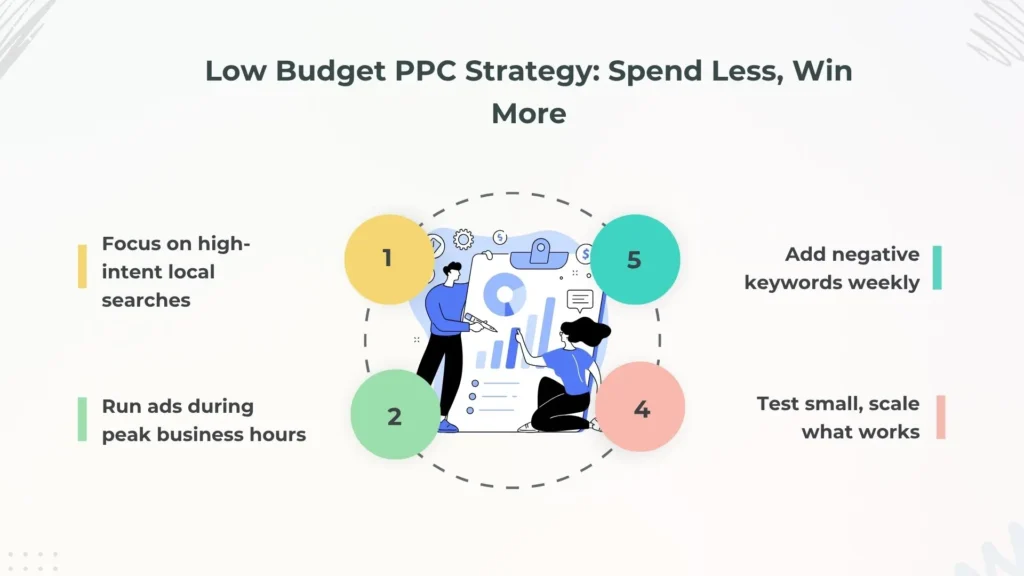
How to implement:
- Regularly check the “Search Terms” report in Google Ads.
- Add irrelevant terms (like “free,” “cheap,” “jobs”) as negatives.
- Use keyword sculpting to focus only on profitable terms.
Example: A dental clinic in Chandigarh blocked negative keywords with dental jobs and DIY teeth whitening, which saved ₹12,000 per month and increased the click-through rate by 24%.
7. Stay Ahead With PPC Trends and New Ad Formats
The final win lies in adaptability. The ppc advertising companies that will take over in 2025 are the ones that are testing out the new forms of ads offered by Google, such as the Demand Gen Ads, video carousels, and image extensions.
Why it works: Small businesses have the opportunity to follow new formats early and be able to avoid crowding with them. Such advertisements are usually lower priced and more engaging.
How to implement:
- Test responsive search ads with multiple headlines and descriptions.
- Experiment with Demand Gen and Performance Max campaigns.
- Track emerging ppc trends through blogs like Search Engine Journal and Google Ads reports.
Example: A Bengaluru-based salon tested video ads under 15 seconds on YouTube Shorts and doubled brand recall without increasing ad spend.
The Bottom Line
These seven wins share a common thread: agility, precision, and intent. Small businesses may not have the luxury of million-dollar budgets, but they do have speed, creativity, and adaptability.
Whether you work with a ppc services provider or manage campaigns in-house, every advantage counts. Focus your energy on strong landing page optimization, smart PPC automation, and data-driven automated bidding strategies that make your ad spend more efficient.
Your size isn’t a limitation, it’s your edge. When you apply these wins strategically, your small business can not only compete with bigger advertisers but outperform them in ROI, lead quality, and adaptability.
With the right ppc marketing services, focused execution, and a disciplined small business ad strategy, every click can bring you closer to becoming the local leader in your space and that’s the kind of win that no big competitor can outbid.
FAQ’s
Small businesses can win by focusing on smart PPC optimization, local targeting, and PPC automation instead of large-scale spending. These methods help maximize ROI with smaller budgets.
You can start with as little as ₹5,000–₹10,000 per month. Focus on a low budget PPC strategy using negative keywords and high-intent local searches to stretch every rupee.
PPC automation uses AI and machine learning to manage bidding, targeting, and ad placements automatically. It saves time and ensures smarter use of ad spend.
It’s critical, your ad only works if your landing page converts. Optimized pages with clear CTAs, local trust signals, and fast loading speeds can double your conversion rate.
AI-powered bidding, automation, video ad formats, and integration with first-party data are the most impactful ppc trends shaping results this year.
A great small business ad strategy combines local focus, automated bidding, constant testing, and creative messaging that highlights unique value helping smaller brands stand out.